Active Vision Drives Industrial Upgrades: DEPTRUM at Munich Shanghai Photonics Fair

The 21st Munich Shanghai Photonics Fair opened at the Shanghai New International Expo Centre. As a bellwether for the global photonics industry, this year’s event was themed “Light Opens a New Era, Momentum Leads the Future” and brought together nearly 1,500 leading companies from around the world to present cutting-edge technologies and industry trends. DEPTRUM was invited to exhibit, showcasing its technology breakthroughs and application capabilities in 3D visual perception.
As one of the fair’s key concurrent forums, the “Collaborative Innovation from Components to Networks” forum drew numerous industry experts and professional visitors. DEPTRUM co-founder and Chief Scientist Dr. Fanglu Lyu was invited to deliver a keynote, sharing insights on the evolution path of visual perception technology and its industrialization.
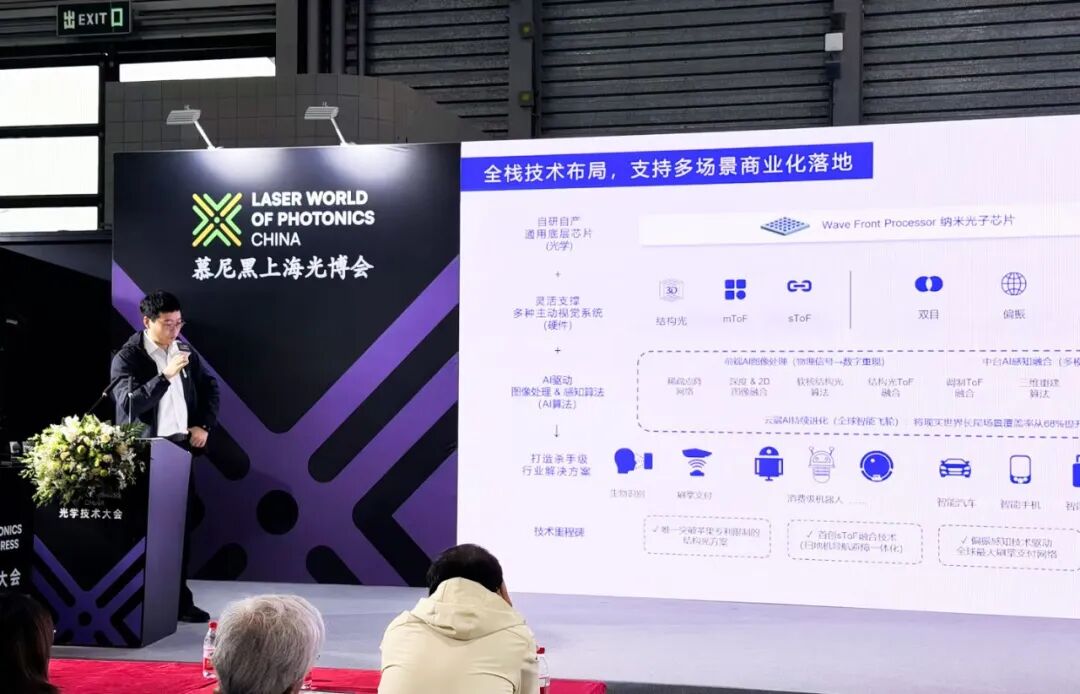
In his keynote, Dr. Lyu noted that as artificial intelligence moves from the “robot learning era” to the “large model era,” vision is rapidly evolving from an auxiliary sensing capability into a core data entry point and key infrastructure connecting the physical and digital worlds. The importance of active vision is increasingly prominent, giving intelligent devices high-precision spatial perception, building a complete data loop and driving intelligent upgrades.
On this basis, DEPTRUM has built a full-stack technology system covering “underlying components — core algorithms — system applications,” continuously advancing the commercial deployment of active vision across diverse scenarios. The company has achieved large-scale application in three major areas — robotics, biometrics and intelligent terminals — closing the perceive–understand–interact loop through multi-dimensional visual perception and accelerating the deep integration of intelligent devices with the real world.
At the fair, DEPTRUM highlighted core products including the Aurora structured light depth camera series and the Nebula sToF depth camera series. Among them, sToF, the company’s independently developed technology, achieves a key breakthrough by replacing conventional multi-sensor architectures with a single sensor, delivering stable perception across the full range from 3cm to 12m. Even in extremely low light of 0.1 lux, obstacle recognition accuracy remains as high as 95%.
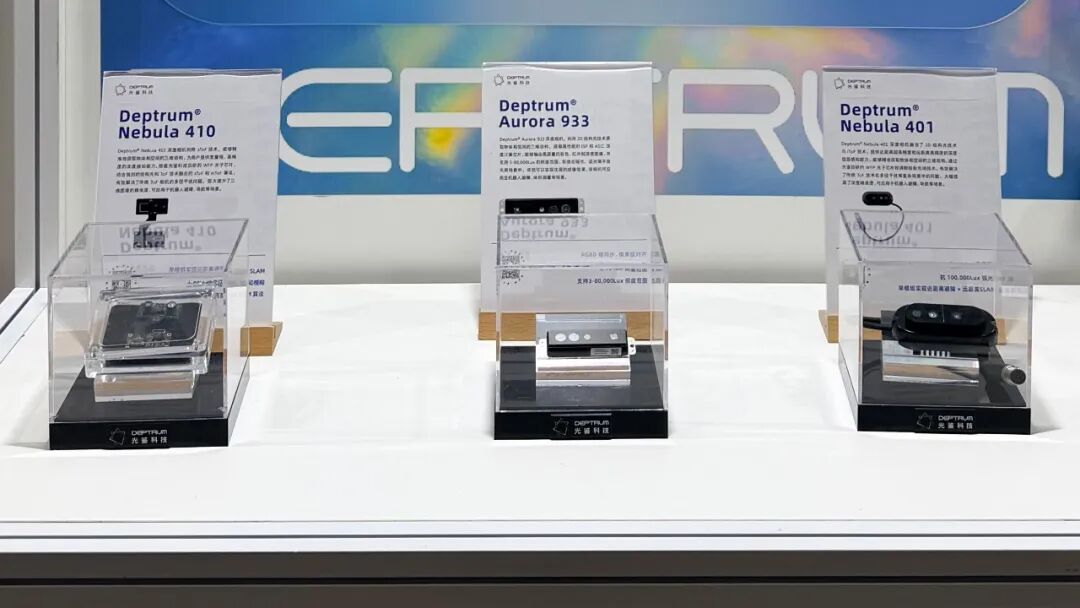
Using the real-time 3D semantic map generated by sToF technology, Nebula series products significantly improve robot efficiency in complex environments, increasing cleaning coverage by up to 100%. This drives the industry’s evolution from “stacked multi-sensor” to “all-in-one single module” architectures and substantially optimizes system structure and cost.
At this year’s Munich Shanghai Photonics Fair, DEPTRUM demonstrated not only solid technology accumulation and product capability but also its core competitiveness in the 3D vision field. Going forward, DEPTRUM will continue to deepen its work in core visual perception technology, guided by scenario needs, accelerating technology innovation and industrial integration and empowering more industries with multi-dimensional visual perception.