DEPTRUM Featured in Chuangyebang & SAP Whitepaper on 3D Vision for Home Cleaning Robots

As artificial intelligence continues to break new ground and industrialization accelerates, embodied intelligence is becoming a major direction for global technology development. As an important carrier connecting the digital and physical worlds, robots are extending from single-function execution to complex scenario applications, and the industry is gradually moving from technology exploration to real-world deployment.
The 2025 Embodied Intelligence Robot Scenario Applications Whitepaper, released by Chuangyebang Research Center in collaboration with SAP, has now been published. Based on a survey of nearly 50 embodied intelligence companies, the report systematically reviews industrial development, technology paths and application scenarios. The collaboration between DEPTRUM and MOVA in home cleaning robots was selected as a typical case in home service scenarios.
The whitepaper notes that the industry is at a critical juncture in the transition from Agentic AI to Physical AI. Embodied intelligence robots carry both the “digital decision-making capability” conferred by large models and the “Physical AI execution capability” enabled by high-precision sensors and dexterous actuation, continuously expanding their application boundaries in the real world.
Against this backdrop of technology evolution, high-precision perception is becoming an important path for upgrading robot capability. Compared with conventional 2D perception, 3D perception based on depth information significantly improves spatial understanding and provides a more reliable data foundation for path planning and decision systems. Particularly in unstructured environments, stable and precise spatial perception is the prerequisite for a high-quality operating experience.
In home cleaning, a typical service scenario, the composite and dynamic nature of the environment places higher demands on robot capability. The whitepaper notes that the home is currently the scenario with the broadest cleaning demand and is also regarded as a key entry point for “understanding the environment and executing composite tasks.” Its development depends on further breakthroughs and cost optimization in core technologies such as visual recognition, autonomous planning and dexterous manipulation.
In this scenario, the DEPTRUM–MOVA collaboration offers the industry a representative technical path. In the whitepaper’s scenario case, the jointly developed home robot vacuum uses a high-precision 3D visual perception solution based on DEPTRUM’s self-developed sToF technology. While maintaining a slim body design, it achieves high-precision perception of complex home environments, striking an effective balance between product form and performance.
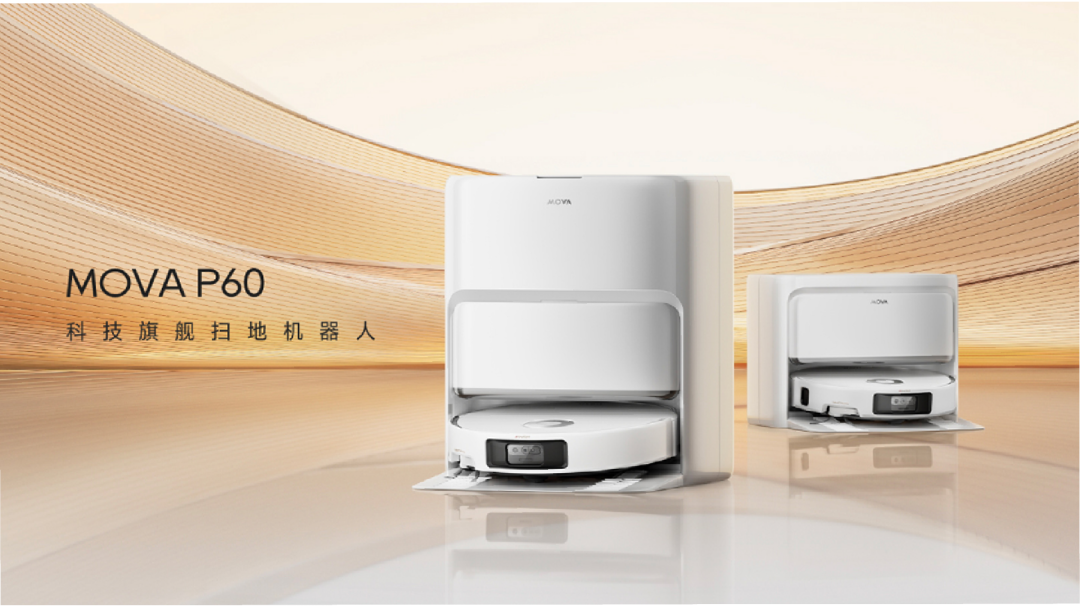
In real-world application, the solution delivers optimized performance across several key capabilities. For low and small obstacles such as cables and carpet edges, it identifies and avoids them more precisely. Under challenging lighting conditions — low light, strong light and backlight — it continues to operate stably, improving all-weather reliability. By closing the perceive–decide–control loop, overall system response efficiency and coordination are further enhanced. The technology has been validated in MOVA’s mainstream robot vacuum products.
From an industry perspective, the whitepaper notes that embodied intelligence robots have long broken free of a single product form. Multiple physical carriers — from general-purpose humanoids to humanoid structures, robotic arms and robot dogs — are all undergoing critical technology iteration. Modular and integrated design has become mainstream, hardware forms are moving toward extreme compactness, and innovation is enabling lightweight design and effective cost control.
By integrating core functions such as obstacle avoidance and navigation into a single sensor, sToF technology aligns with the trend toward higher integration and reliability in perception systems, and has become one of the key reasons for its adoption across multiple industries. On this basis, DEPTRUM continues to advance productization and scenario-specific applications of sToF. It has achieved large-scale deployment in home cleaning and is expanding into commercial robots and more scenarios, gradually building a capability system that spans core components, system solutions and multi-scenario replication.
Being featured in the whitepaper jointly released by Chuangyebang and SAP reflects DEPTRUM’s technical capability and real-world practice. Going forward, DEPTRUM will continue to deepen its work in 3D visual perception technology, expand applications in robotics and intelligent terminals, and drive the deployment of related technologies in more real-world scenarios.