Selected as a MIIT Typical Case: DEPTRUM Leads a New Direction in Robot Visual Perception

China’s Ministry of Industry and Information Technology (MIIT) has published its “2024 Outstanding Typical Cases of Future Industry Innovation and Development.” This year’s selection focused on six directions — future manufacturing, future information, future materials, future energy, future space and future health — across three categories: iconic products, leading enterprises and typical application scenarios, identifying benchmark cases with technological breakthroughs, industrial driving force and application demonstration value.
Among the selected cases is “Application of General Brain-Inspired Visual Perception Technology in Intelligent Robots,” jointly developed by Dreame Innovation Technology (Suzhou) Co., Ltd. and DEPTRUM. The project is one of the key representatives of integrated innovation in future information and future manufacturing. The achievement reflects both companies’ sustained innovation in robot intelligence and further demonstrates DEPTRUM’s leading technical strength and industrialization capability in visual perception.
As a core technology partner, DEPTRUM was deeply involved in project R&D and product deployment. In Dreame’s latest flagship robot vacuum, the L60 Ultra, DEPTRUM built an AI 3D ToF full-scenario visual perception solution based on its self-developed sToF technology, achieving the industry’s first mass-produced single 3D ToF module that combines obstacle avoidance and 3D SLAM — bringing robot vacuum visual perception into the 3D SLAM era.
At low cost and in a small form factor, the solution unifies a wide field of view, high frame rate and high precision. A single sensor simultaneously handles whole-home obstacle avoidance and 3D SLAM mapping, effectively addressing the challenges robots face in complex environments: insufficient perception accuracy, weak environmental adaptability, and the difficulty of balancing compute and cost. Compared with conventional multi-sensor architectures, the higher level of integration not only optimizes the overall space design but also closes the full perceive–decide–control loop, further improving the robot’s overall response efficiency and coordination.
In real-world application, the solution shows clear advantages in several key scenarios. For low, small and hard-to-recognize obstacles such as thin chair legs and glossy floor tiles, the system reconstructs object boundaries more precisely and avoids them reliably. Under challenging lighting conditions — low light, strong light and backlight — it continues to operate stably, significantly improving all-weather reliability. Through multimodal image fusion, the robot accurately identifies different forms of solid and liquid stains and applies targeted mopping for a smarter cleaning strategy.
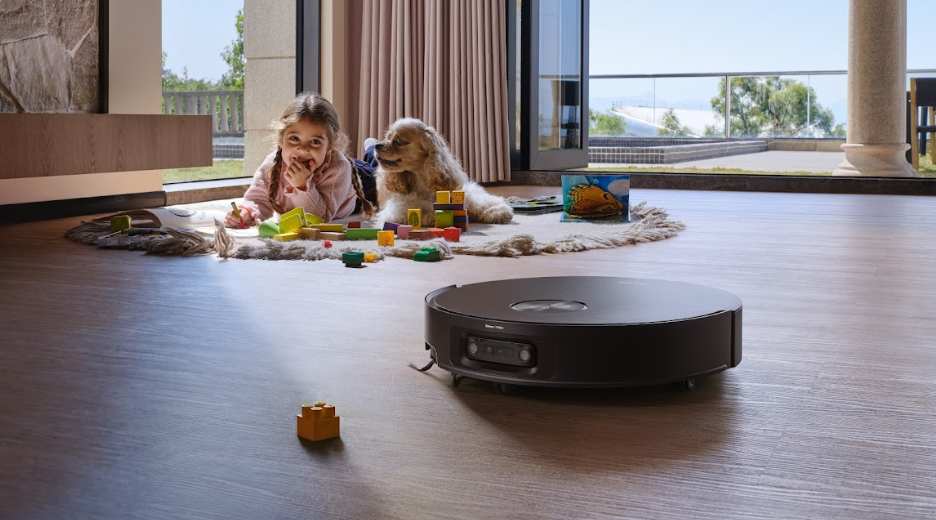
At the scale-up level, the DEPTRUM–Dreame collaboration offers the industry a representative technical direction, driving robot perception systems to evolve from “multiple stacked sensors” toward “highly integrated single sensors.” Around its core sToF technology, DEPTRUM continues to advance productization and scenario-specific applications. While achieving large-scale deployment in home cleaning robots, it is also accelerating expansion into commercial robots and more intelligent terminals, gradually building a complete capability system spanning core components, system solutions and multi-scenario replication.
Selection as a MIIT typical case is further recognition of DEPTRUM’s technology innovation and industrial deployment capability in 3D vision and active perception. Going forward, DEPTRUM will continue advancing active vision technology, accelerating the intelligent upgrade of robots and related industries, and continuously expanding the boundaries of how machines understand the world.