From “Can Talk” to “Truly Cares”: What AI Companion Robots Still Lack

With advances in large models, AI companion robots are entering a new phase of development. From children’s education and elder care to household assistance, robots now have increasingly natural language interaction capabilities. In the past, the question was whether a robot could understand instructions; today, people expect robots to understand needs, act proactively and become genuine household companions.
For companion robots, however, conversation is only the baseline. True companionship does not happen only in dialogue — it is reflected in continuous perception and understanding of the user’s state and changes in the environment.
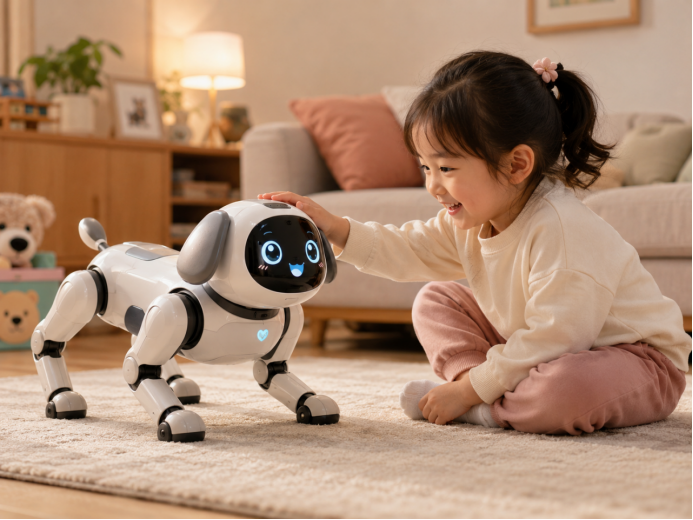
Image generated by AI
For example, a robot should proactively check in when an elderly person has been inactive for a long time, alert caregivers when a child behaves abnormally, or respond to a user’s needs the moment they enter a room. Behind these capabilities, the robot must perceive its surroundings in real time, recognize user behavior and make judgments and responses appropriate to the context.
This means that the competitive focus for companion robots will no longer be language model capability alone, but the co-evolution of the “brain” and the “senses.” A robot must not only understand what a user says, but also know where the user is, what they are doing and what is changing in the surrounding environment.
In fact, 3D vision has already become a foundational element of robot perception systems. Whether home robots, quadruped robots or service robots, all rely on three-dimensional perception for navigation, obstacle avoidance and environmental understanding. But as robots take on more complex tasks such as companionship, service and long-term interaction, the industry’s demands on 3D vision are rising.
For an AI companion robot, spatial perception alone is no longer sufficient. What matters more is perception accuracy, environmental adaptability and long-term operational stability. Home environments are full of dynamic changes: lighting shifts, furniture rearrangement and human activity all challenge the perception system. Robots need to continuously and stably obtain high-quality visual perception data in complex scenarios to support higher-level behavior understanding and proactive interaction.
Against this backdrop, DEPTRUM’s sToF technology offers a new direction for upgrading robot perception. sToF combines the strengths of structured light and ToF, enabling a single depth camera to handle navigation, obstacle avoidance and spatial perception simultaneously, further improving environmental adaptability and system stability while maintaining perception accuracy.
It is built on DEPTRUM’s self-developed nanophotonic chip (WFP) as an underlying core technology, striking a balance between high performance, low power consumption and mass-production capability. Combined with 3D reconstruction, object recognition and point-cloud segmentation algorithms, robots can understand spatial environments and user behavior more precisely, providing reliable support for long-term companionship in the home.
SLAM mapping results produced by sToF technology in a real-world scenario
The Nebula series of depth cameras built on sToF technology effectively addresses the key challenges facing companion robot perception. With excellent perception performance and outstanding resistance to strong light, the Nebula series delivers stable and reliable 3D perception for AI companion robots, allowing them to continuously obtain accurate spatial information in complex indoor and outdoor environments. This not only improves navigation and obstacle avoidance, but also provides a solid foundation for behavior recognition, proactive interaction and scene understanding.
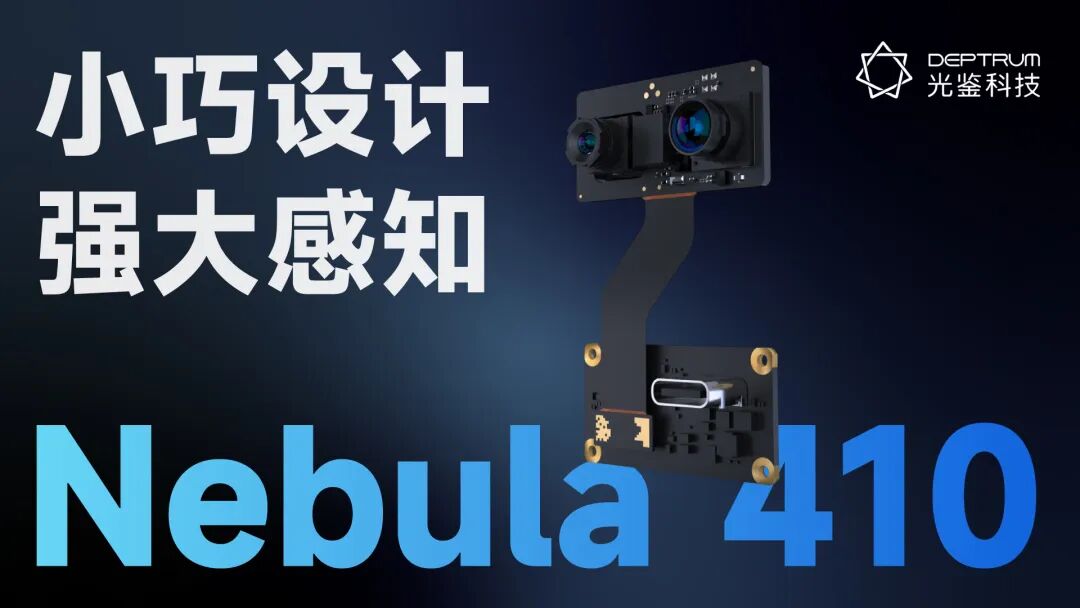
Looking at industry trends, large models solve the problem of robots being able to communicate, while advanced 3D vision technology solves the problem of robots being able to perceive and understand. A truly excellent AI companion robot in the future will not only respond to every word a user says, but also proactively perceive needs, understand context and offer help at the right moment.
In the journey from “can talk” to “truly cares,” what robots have always lacked is not just a more powerful language model, but also more advanced and reliable perception. Only when large models and next-generation 3D vision converge can a robot grow from a chatting device into an intelligent companion that genuinely becomes part of family life.