DEPTRUM Releases Embodied AI Visual Perception Solution for Physical AI

With the rapid development of multimodal foundation models, VLA, and related technologies, embodied intelligence is accelerating toward industrialization. Robots now possess increasingly strong understanding, reasoning, and decision-making capabilities. Yet once they enter real scenarios such as homes, factories, and commercial spaces, what determines their practical capability is not only how smart the “brain” is, but also whether they can accurately perceive and understand the physical world.
Autonomous navigation, fine grasping, human-robot interaction, and other capabilities are all built on reliable 3D visual perception. Visual perception is not merely the output of depth data — it is a critical foundation for robots to understand the environment and execute tasks. How to continuously deliver precise, stable, and efficient visual information in complex scenarios has become a key foundation for scaling embodied intelligence into real-world applications.
Based on this trend, DEPTRUM officially releases its Embodied AI Visual Perception Solution. Centered on AI binocular vision technology and integrating intelligent perception algorithms with an efficient computing architecture, the solution provides robots with visual capabilities covering core scenarios such as environment perception, spatial understanding, navigation and localization, and fine manipulation, helping embodied intelligence accelerate into the real world.
Why does embodied intelligence need stronger visual perception?
As embodied intelligence moves into the real world, robot vision is facing new challenges.
First, real environments are more complex. Transparent glass, highly reflective metal, weakly textured walls, black objects, and other challenging scenes are widespread, placing higher demands on the completeness and stability of depth information. Traditional binocular stereo matching tends to suffer from depth missing and point-cloud noise in these scenes, undermining embodied AI’s accurate understanding of the environment and, in turn, the execution of obstacle avoidance, grasping, navigation, and other tasks.
Second, the tasks undertaken by embodied AI are more diverse. From navigation and obstacle avoidance to grasping and manipulation, and on to human-robot interaction, a vision system must not only output high-quality depth information, but also simultaneously support SLAM localization, object detection, VLA inference, and other tasks, achieving efficient coordination between perception and intelligence.
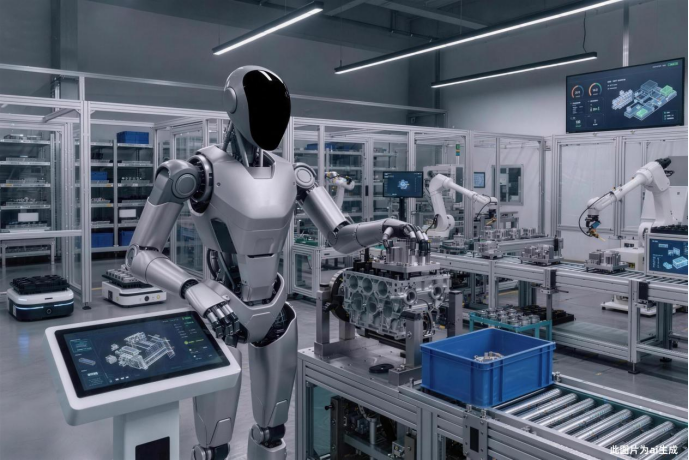
Finally, on-device compute is more precious. As foundation models are progressively deployed on embodied AI, limited computing resources must simultaneously support perception, localization, planning, and reasoning. How to reduce compute consumption while maintaining perception quality, freeing up more computing power for intelligent reasoning, has also become an important direction for robot visual perception.
Competition in robot visual perception is no longer confined to single-hardware performance; it is about finding a new balance among perception quality, system coordination, and computing efficiency. What embodied intelligence truly needs is not more vision hardware, but a more efficient, reliable, and unified set of visual capabilities.
DEPTRUM’s answer: more accurate, more stable, and more efficient robot perception
Addressing the development needs and real pain points of embodied intelligence, DEPTRUM releases its brand-new Embodied AI Visual Perception Solution, building visual capabilities that cover robots’ diverse application scenarios through AI binocular vision, an omni-domain generalization design, and an efficient computing architecture. DEPTRUM’s answer is not merely a more powerful depth camera, but a visual perception solution that can support the continuous evolution of embodied intelligence.
AI binocular vision: seeing complex scenes more accurately
DEPTRUM brings AI algorithms into binocular vision, achieving a comprehensive upgrade of spatial perception through its self-developed high-performance stereo matching algorithm.
Unlike traditional binocular vision, which relies on local texture matching, AI binocular vision develops a deeper understanding of scene structure and object relationships. When facing complex materials such as transparent glass, highly reflective surfaces, and black objects, it maintains stable depth recovery and outputs high-quality depth maps with continuous edges, rich detail, and complete structure, achieving stable reconstruction of millimeter-level details.
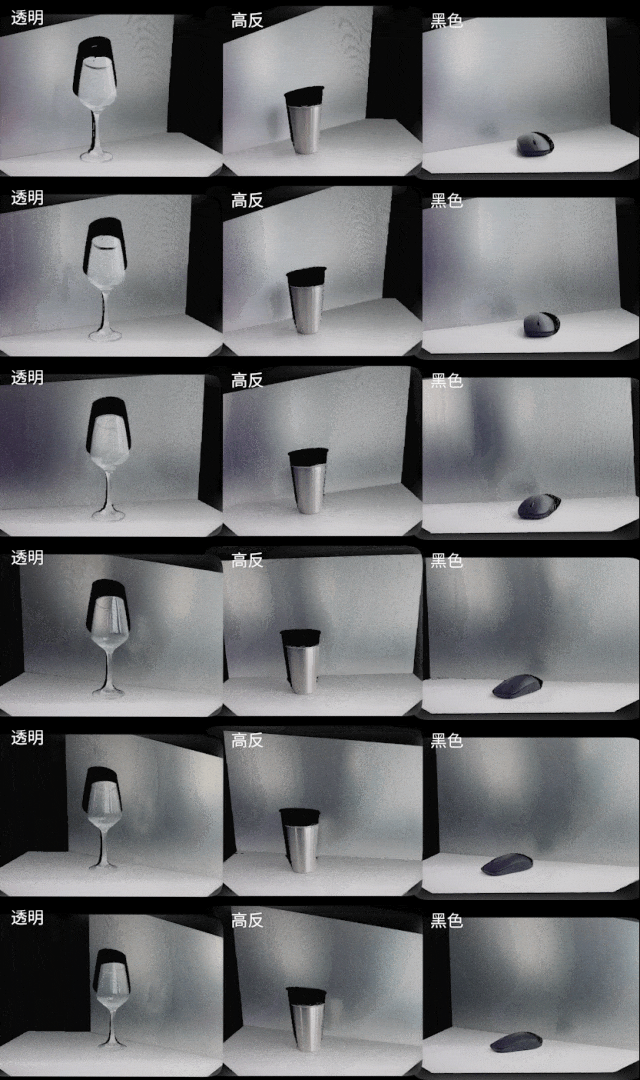
Libra 1000 point-cloud demonstration across different materials
For close-range reconstruction of small objects, DEPTRUM’s embodied AI visual perception solution provides richer visual detail and precise binocular constraints, producing reconstructed point clouds with clearer object contours, sharper edges, and smoother continuous surfaces — better meeting the application needs of fine robot manipulation, obstacle avoidance, and spatial understanding.
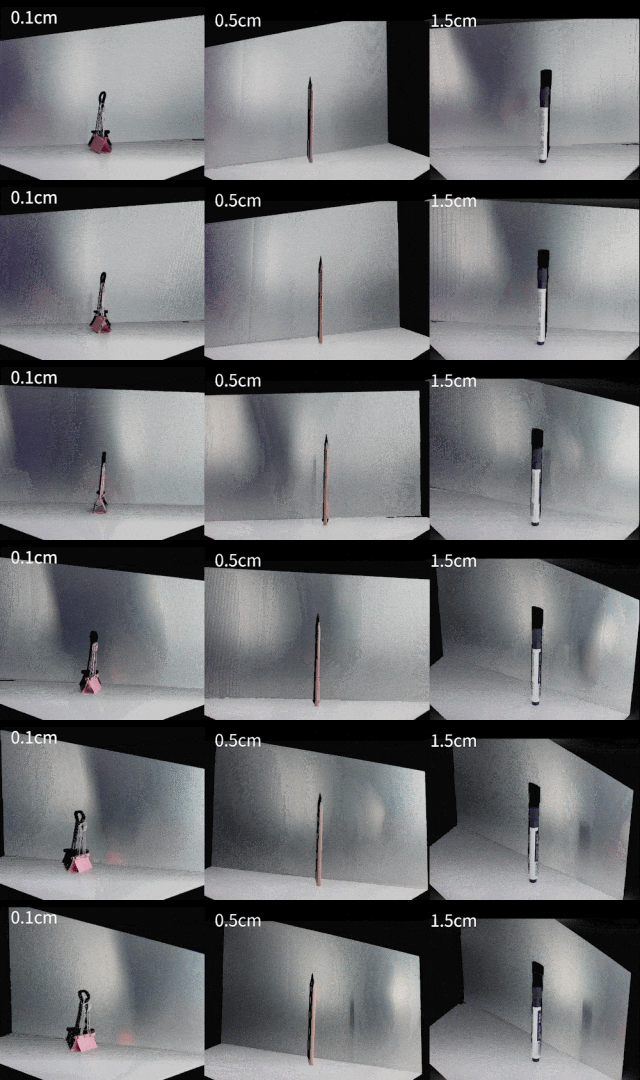
Libra 1000 point-cloud demonstration for small objects
(0.1 cm refers to the narrowest part of a long-nose pliers handle; 0.5 cm and 1.5 cm refer to the diameters of a pencil and a marker)
In complex transparent-glass scenes, DEPTRUM’s embodied AI visual perception solution effectively combines image features with spatial structure information, reducing matching interference caused by transparent materials and improving the depth completeness and stability of transparent regions, providing more reliable depth information for robot obstacle avoidance and path planning in real environments.

Libra 3000 rendering demonstration in complex transparent scenes
In weakly textured scenes, DEPTRUM’s embodied AI visual perception solution breaks free from reliance on local texture features, making comprehensive judgments that combine object edges, geometric structure, and spatial relationships. This effectively reduces depth anomalies caused by missing texture, so that step edges, vertical surfaces, and height changes are represented more accurately, enhancing robots’ spatial understanding in complex environments.
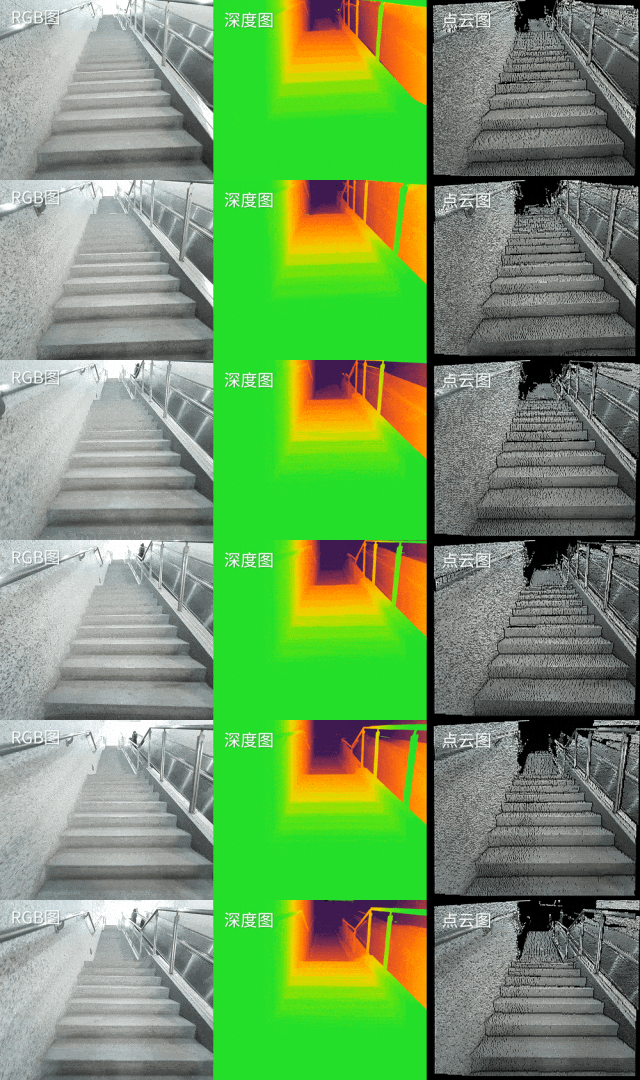
Libra 3000 rendering demonstration in weakly textured complex scenes
Omni-domain generalization: one vision system for more tasks
DEPTRUM’s embodied AI visual perception solution adopts an omni-domain generalization design, using one unified hardware platform to support depth perception, SLAM localization, object detection, and other tasks — a single vision system covering robots’ diverse scenarios and task needs, with continued OTA upgrades. Compared with traditional solutions that configure separate sensing hardware for different functions, the omni-domain generalization design further improves the versatility and multi-task coordination of the vision system, building more unified and efficient visual capabilities for embodied intelligence.
An efficient computing architecture: more compute for intelligent decision-making
By optimizing the perception computing architecture, DEPTRUM’s embodied AI visual perception solution drastically reduces compute requirements, stably outputting high-quality, high-frame-rate depth images with limited computing resources and leaving more compute for core tasks such as VLA inference and SLAM localization — reserving greater headroom for the intelligent upgrade of embodied AI.
Libra series: covering manipulation and spatial perception
Addressing the two core vision needs of robot manipulation and mobility, DEPTRUM introduces the Libra series of AI binocular vision modules, covering embodied AI’s core applications from close-range fine manipulation to medium- and long-range spatial perception.
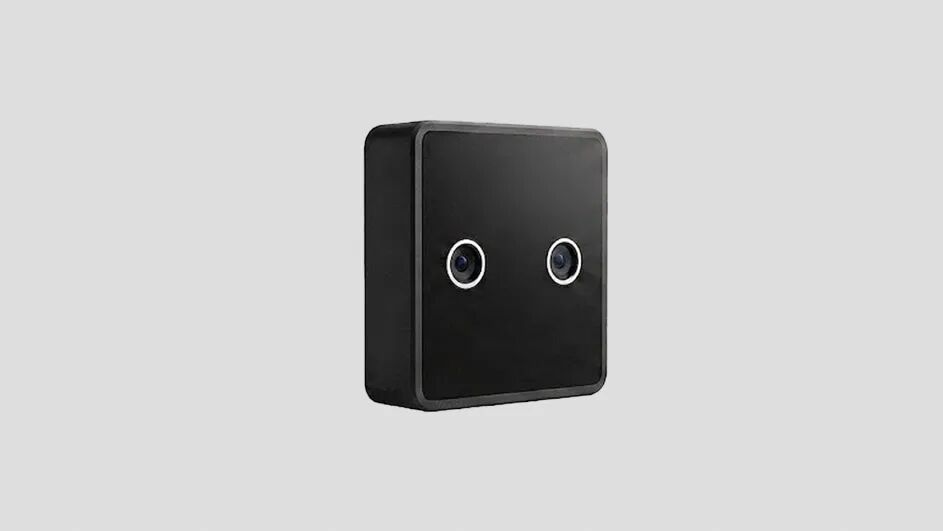
Libra 1000: for close-range fine manipulation
Libra 1000 features a 2 cm baseline design and is positioned for wrist-level manipulation perception. It suits scenarios such as robotic-arm grasping, dexterous-hand operation, teleoperation, and data collection, providing reliable close-range vision for fine embodied AI manipulation. In addition, the product supports an optional binocular fisheye lens, achieving a horizontal field of view of over 180°, effectively widening the near-field observation range to the greatest extent and meeting the demanding FOV requirements of close-range grasping tasks.
Libra 3000: for medium- and long-range spatial perception
Libra 3000 features a 7 cm baseline design and is positioned for head-level spatial perception, mainly applied to medium- and long-range obstacle avoidance, SLAM localization, and spatial mapping. With stable spatial perception and high-quality point-cloud output, it provides reliable support for autonomous mobility, environmental understanding, and spatial interaction. In addition, Libra 3000 can integrate spatial perception algorithms internally, fusing spatial understanding on top of the 3D vision hardware to unify image capture, depth computation, and spatial perception.
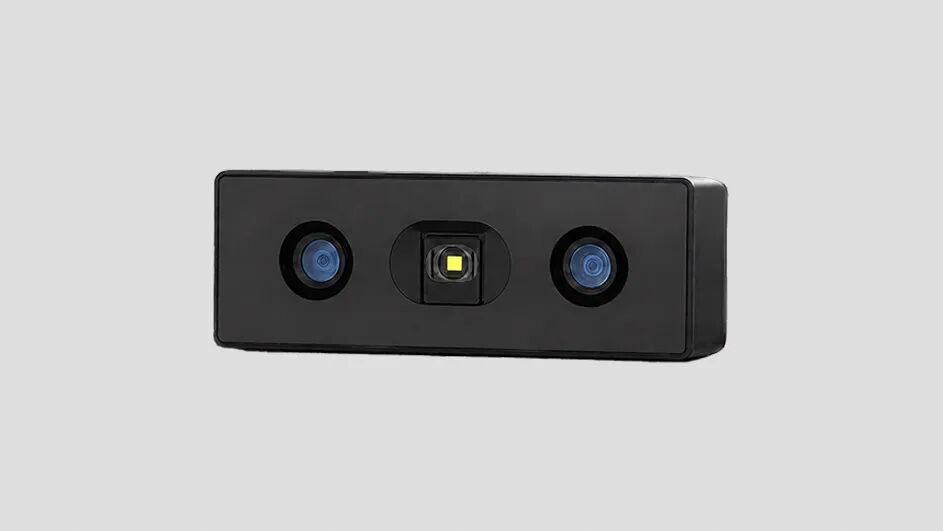
Both products support GMSL high-speed output, adapting to mainstream robot platforms and covering robots’ core vision needs from manipulation to navigation, laying a solid visual foundation for the deployment of embodied AI applications.
From 3D vision to the visual perception infrastructure for physical AI
As embodied intelligence continues to expand into real-world scenarios, visual perception is evolving from a single hardware capability into a key foundational capability that supports robots’ autonomous perception, decision-making, and execution.
The release of this embodied AI visual perception solution marks an important strategic move by DEPTRUM for the physical AI era. Going forward, DEPTRUM will continue to drive the coordinated evolution of AI algorithms, vision hardware, and perception computing, enabling robots to better understand the physical world and propelling embodied intelligence toward large-scale application.