Innovation Never Stops: DEPTRUM on the Road Against Involution

Independent innovation is an inevitable choice for technology companies —
and a beacon of moving against the current in a capital winter.
The global competitiveness of Chinese companies is shifting from “competing on labor and capacity” to a new stage of “competing on technology and innovation.” According to the World Intellectual Property Organization's World Intellectual Property Indicators report, China filed about 1.6 million patent applications in 2022, ranking first in the world. And in the recently released ranking of the world's top 100 science and technology clusters, the number of Chinese clusters ranked in the global top 100 jumped to first place for the first time.
In the capital market, independently innovative companies are not constrained by the so-called “capital winter.” Recently, DEPTRUM, which just completed a RMB 200 million Series B, won capital's favor precisely by converting “technological innovation” into commercial and industrial value.
“Relying on fundamental technological innovation, breaking through patent blockades, and already achieving commercial adoption,” said Chen Yanbo, head of Kexing Sci-Tech Investment. DEPTRUM's balance of innovative technology and commercialization brings the capital market a different investment experience.
Clearly, whether from the perspective of global competition or enterprise development, independent innovation is becoming ever more important — even mandatory. So what does insisting on independent innovation really mean?
1
Innovation never stops: from breaking industry barriers to constantly widening the technology boundary
Independent innovation has two layers of meaning: innovation, and technological self-reliance — neither can be missing. This is a product requirement and, even more, a requirement for commercial adoption. Especially in an increasingly complex international situation, technology that is not self-reliant can hardly achieve true innovation, let alone greater commercial value.
In 2017, Apple introduced Face ID in the iPhone X, applying 3D structured light at scale to the consumer market for the first time — an industry inflection point for the global 3D vision industry. But seizing this opportunity and sharing the dividends of technological change required technological self-reliance.
Unfortunately, Apple's technological self-reliance was not friendly to domestic companies. Apple's “VCSEL (vertical-cavity surface-emitting laser) + DOE” 3D structured light scheme carried all-around “patent protection,” bringing domestic companies both “industrial opportunity” and patent risk and supply chain barriers.
Following convention — developing products along the “Apple scheme” with only incremental application-level upgrades — would have made domestic companies perpetual “chasers.” Moreover, imitation creates no real barrier: products would homogenize, and the industry's many imitators would face inevitable involution from the start. Viewed differently, there is no “make-do” middle option when it comes to barriers; when barriers are at stake, “independent innovation” is the one and only optimal solution.
Break before you build; stagnate and you perish.
DEPTRUM thus formally began its road against involution — the “EEL (edge-emitting laser) + WFP (nanophotonic chip)” scheme not only broke Apple's patent barriers, but delivered higher efficiency and lower cost than Apple's approach, and localized core components, effectively advancing domestic development from technology to supply chain.
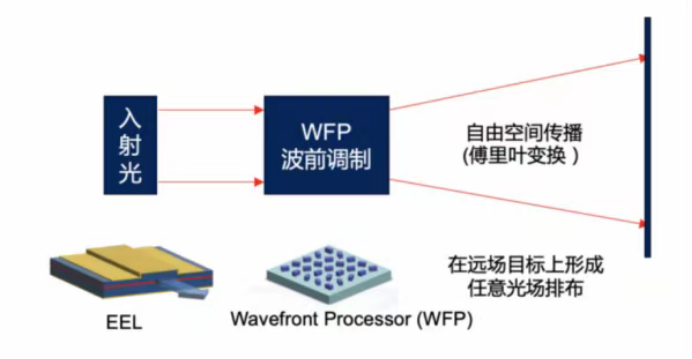
DEPTRUM “EEL+WFP” scheme diagram
On this basis, DEPTRUM partnered with ZTE to build the first true full-screen phone, breaking Apple's 100,000-lux outdoor performance requirement, and together with OPPO launched a flexible OLED under-display 3D concept phone — giving domestic companies “more autonomous choices” in competing for the global technology high ground.
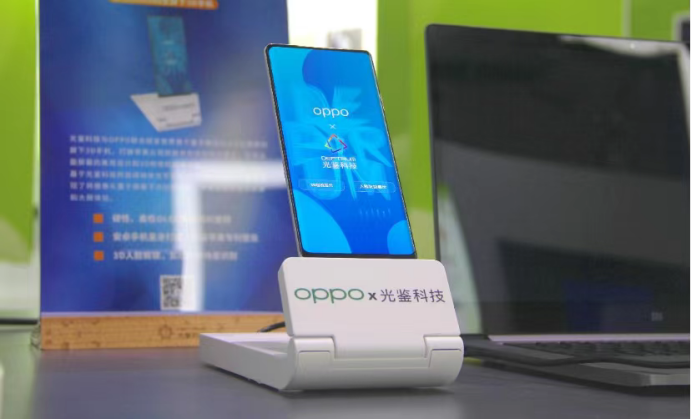
First flexible OLED under-display 3D concept phone
The greatest significance of the smartphone partnerships is that Chinese technology companies shattered the stereotype of technology imitation, using technical barriers and test data ahead of Apple's scheme to prove that DEPTRUM's technology stands at the international leading level.
Meanwhile, market demand is widening the growth space of technology companies across different tracks, and independent innovation has become DEPTRUM's advantage in pursuit, achieving a one-plus-one-greater-than-two effect.
DEPTRUM's proprietary sToF technology uses just one set of optical hardware to let a robot perform both structured-light and ToF depth reconstruction, achieving ultra-high-precision close-range and high-precision mid-to-long-range 3D imaging. Combined with DEPTRUM's 3D vision perception capability, fundamental principle-level innovation delivered a double breakthrough in performance and cost.
Machine vision is not limited to dimensions the human eye can perceive. Beyond the three dimensions of space, there are polarization, phase and other highly valuable physical information — multi-dimensional vision beyond 3D is the future direction of AI perceiving the world. Multi-dimensional vision can not only accurately capture the exterior shape of a target, but also image internal textures — for example, capturing both palm prints and palm veins simultaneously for more secure and convenient biometric scenarios.
This May, WeChat palm-payment gates with hardware provided by DEPTRUM were deployed across the entire Daxing Airport Line, marking the formal arrival of the palm-payment era. Since then, the technology has landed in transportation, sports, campus, retail, dining, office and shared-charging scenarios, constantly widening the application boundary of palm-scanning technology.
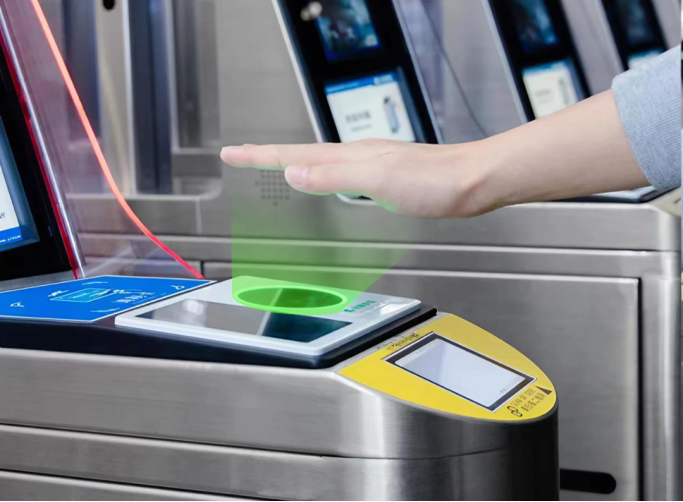
Passengers palm-scanning on the Beijing subway Daxing Airport Line
It is clear that through persistent independent innovation, DEPTRUM now has both its “footing” — becoming an industry-leading provider of 3D vision solutions — and its greater “path of development”: through independent innovation, to be the linker of visual information from the digital world to the real world in the era of the Internet of Everything.
2
Besides innovation, DEPTRUM never considered any other option
Insisting on independent innovation — doing industry-leading, even first-ever things — is certainly cool, but also high-risk. Yet in DEPTRUM's view, a technology company without innovation has no reason to exist.
On one hand, under the deglobalization trend, innovation that skips fundamental fields and stays at upper-layer applications can easily be targeted and “choked off.” On the other, as Chinese technology develops rapidly and leads globally in many fields, there are no more “imitators” ahead — one can only be a “pioneer.” Against these two backgrounds, independent innovation is mandatory.
Liu Tao, general manager of Yicun Songling, which participated in multiple rounds of DEPTRUM's financing, said that against the backdrop of deglobalization, technological self-reliance and a self-sufficient supply chain are especially important. This is why he favors DEPTRUM: the core founding team, represented by Dr. Zhu Li, combines technology, product and engineering — from “face scanning” to “palm scanning,” from “under-display 3D perception” to “3D vision infrastructure” — fully demonstrating their commercial acumen as outstanding technology entrepreneurs.
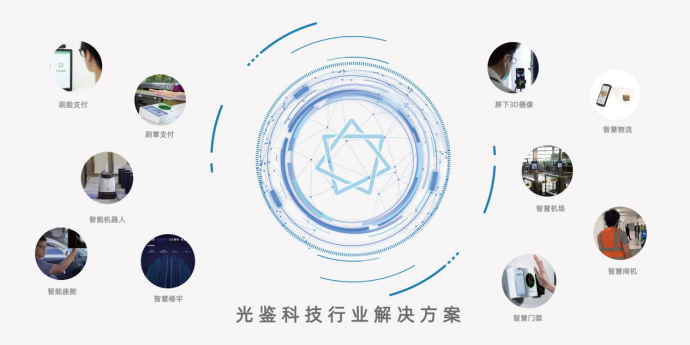
DEPTRUM industry solutions and commercial adoption areas
The experience and capability DEPTRUM accumulated in the “perception cycle,” together with the team's big-tech DNA and international vision, also convince investors that DEPTRUM will keep achieving self-breakthroughs in the AIoT era. Because they do not compete inwardly with the market, but outwardly toward technology — aiming at market needs and pain points and innovating more pragmatically.
From “face payment” to “palm payment” is a good example. Face payment has become a mainstream mobile payment method, but in both convenience and user experience there is still room for upgrading.
Compared with face payment, palm payment offers higher initiative — there is no need to align with a camera; simply extending a palm completes payment. Moreover, palm-payment devices do not necessarily need a screen for interaction, saving both space and hardware cost and opening possibilities in more scenarios.
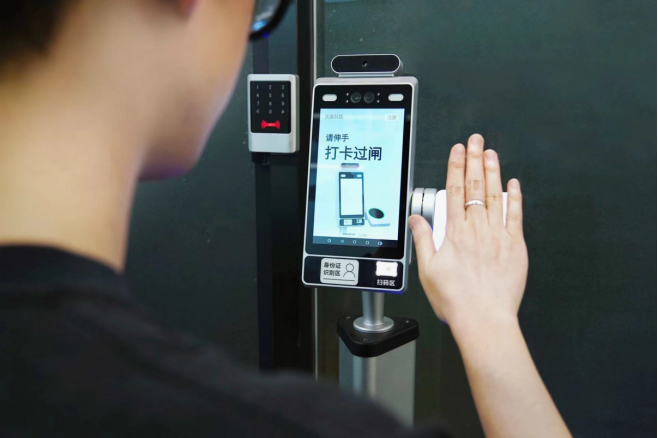
Palm-scan gate application scenarios
DEPTRUM's innovation is therefore not about solving a newly invented problem, but about asking which sufficiently valuable problems in the world are solved insufficiently well — and solving them with more effective methods.
The same thinking shows in the smart cockpit field. DEPTRUM launched a software-hardware integrated 3D vision smart cockpit solution, evolving cockpit interaction into full-cabin intelligent interaction combining vision, voice and hearing. This upgrade does not break the existing smart cockpit landscape; based on 3D vision perception, it gives drivers and passengers a more intelligent, convenient and humanized experience — which is what DEPTRUM believes the smart cockpit is about.
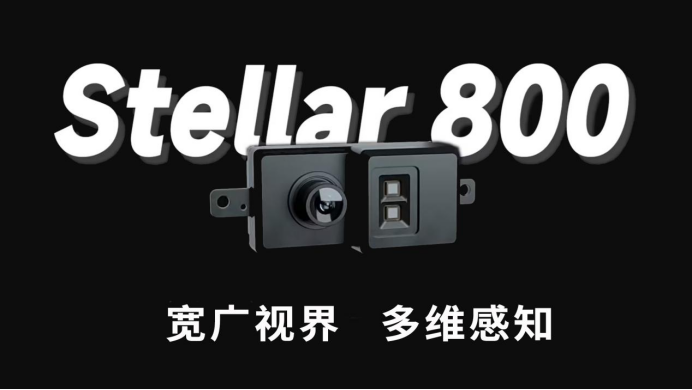
DEPTRUM automotive-grade 3D depth camera
This mindset gives DEPTRUM a deeper understanding of the market, letting technology better empower industry and users — no longer innovating for innovation's sake — and achieving a perfect closed loop from technological innovation to commercial adoption.
3
Not competitor-oriented: focus on innovation and you have no rivals
As is well known, 3D vision is called the fourth visual revolution — the “eye of intelligence” on smart devices — widely used in phones, cars, payment, robotics and many other fields, a rapidly growing hundred-billion market.
The market is big, but also highly competitive. How to break the “involution”? DEPTRUM's answer: don't focus energy on competitors, don't engage in “ineffective involution” for sales figures — focus on technological innovation and grind hard on market demand. This gives it “no rivals” in its key businesses.
“No rivals” does not mean no industry competition — it means carving out DEPTRUM's own path through independent innovation.
In fact, the 3D vision chain is long with many differentiation options: companies can start from hardware or software, break through in optics, or make their mark in algorithms and computing — everyone can take a slice.
But DEPTRUM chose full-chain independent innovation with a full-stack technology layout. Combining optical sensing, intelligent perception and perception computing into a complete optics + software + hardware system, it provides common visual perception capabilities for AI across scenarios, making technology commercialize faster and better and fit market needs better — these constitute DEPTRUM's core competitiveness.
Being able to do this stems partly from three founders who hold PhDs from UC Berkeley and Stanford with deep accumulation in optics and algorithms; and partly from DEPTRUM's top-tier optics and 3D vision team — 80% of employees are R&D staff from top domestic and international universities with excellent industry experience and innovation capability.
Most importantly, DEPTRUM chooses directions by the first principles of technology, providing more services with fewer product lines and adapting to more scenarios. The main reason is that DEPTRUM focuses on solving the interaction between smart devices, people and physical space, summarizing technological commonalities to create the greatest-common-denominator technology route — a more efficient direction for independent innovation.
This is one reason capital favors DEPTRUM. Chen Yanbo of Kexing Sci-Tech Investment said that 3D vision is a key entry point for data reshaping at the perception layer in the AI era, highly reusable across mobile payment, consumer electronics, automotive cockpits and robotics, and can bring users unprecedented interactive experiences. DEPTRUM has assembled a top-tier team from the optoelectronics industry chain, broken patent blockades through fundamental innovation, and achieved commercial adoption — it will become a leading enterprise of the 3D vision industry.
Simply put, DEPTRUM has not only stepped onto the “no-rivals” innovation road of vision infrastructure for the Internet of Everything, but has proven itself a fast-moving “train” in technology and commercial adoption, and has accumulated the momentum of deep preparation in talent — naturally becoming the “prized catch” of capital and market.
4
Epilogue
Wang Xing, founder of Meituan and fellow Tsinghua alumnus, once said that only by finding the intersection between the general direction of user needs and the direction of technological change can one ride the “crest of the wave” of the era.
Looking back at DEPTRUM's development — from under-display 3D in smartphones, to palm payment in finance, to spatial interaction in robots and smart cockpits — each time it landed precisely on the combination of market demand and technological change, and caught wave after wave of the times with real capability.
Now, with perception maturing and algorithms and computing improving, 3D vision technology has become the visual perception foundation of the Internet-of-Everything era. DEPTRUM, committed to independent innovation as the linker of visual information, is leveraging its 100% self-controlled 3D vision technology to step onto the grand stage of the Internet of Everything, constantly moving toward the “crest of the wave” of the intelligent perception era.