Technology Genes and Independent Innovation: DEPTRUM Shapes a New Paradigm of 3D Vision Perception

According to statistics from the Gaogong Robot Industry Research Institute (GGII), China's machine vision market is expected to exceed RMB 56 billion by 2027, of which 3D vision will approach RMB 16 billion — nearly 30%. 3D vision perception technology has already penetrated smart vehicles, industrial robots, service robots, smart cities, new retail and smart homes. With its outstanding advantages of high precision, high speed, strong adaptability and strong anti-interference, the rapid development of 3D vision perception is unstoppable.
The industry's heat lets related companies benefit first. In the 3D vision perception track, DEPTRUM, founded in 2018, has ridden the industry wave to grow from a rising star into a leading 3D perception company. In December 2023, DEPTRUM completed a RMB 200 million Series B, entering a brand-new stage of development.
Dr. Zhu Li, founder & CEO of DEPTRUM, said in an interview with EETop China that completing a Series B usually means the company's products have passed initial market validation and achieved certain market results. Over the past two to three years, DEPTRUM's business has grown several-fold every year. “It lets investors see that we are in a very good state of development — a very high-quality investment target.”
Generally, before a Series B a company has proven the feasibility of its business model and the value of its technology and products; after it, the company needs to further expand business scale, strengthen financial and governance structures, and open new markets. Without doubt, the Series B is a milestone. So what changes will DEPTRUM see after this round? DEPTRUM has its own answers.
Avoiding market involution: continuously building differentiated 3D vision solutions
Machine vision has developed in industry for decades — previously mostly 2D vision. 2D vision is driven by planar contours of objects and cannot obtain curvature, spatial coordinates or other 3D parameters. Moving from 2D to 3D perception is therefore a technological leap. With the maturing of underlying hardware and algorithms, 3D perception is no longer confined to industry — it has entered all the broad fields mentioned above.
Historically, the main technical schools of 3D vision have been binocular stereo, 3D structured light, laser triangulation and ToF (Time of Flight). DEPTRUM further pioneered the sToF (structured ToF) scheme — a hardware system designed on nanophotonic-chip-modulated projected light fields, requiring just one set of optical hardware to simultaneously perform structured-light and ToF depth reconstruction; combined with proprietary algorithms, it achieves ultra-high precision at close range and high precision at mid-to-long range.
Zhu Li said that from its founding in 2018 to today, DEPTRUM has focused on 3D vision sensing, with the goal of helping industries achieve better visual perception through its technologies. “Now we have gone deeper in this field, completing the upgrade from technology to products and starting the commercialization process. From 'face scanning' to 'palm scanning,' from 'under-display 3D perception' to '3D vision smart cockpit,' these hot solutions all use DEPTRUM's 3D vision perception technology.”
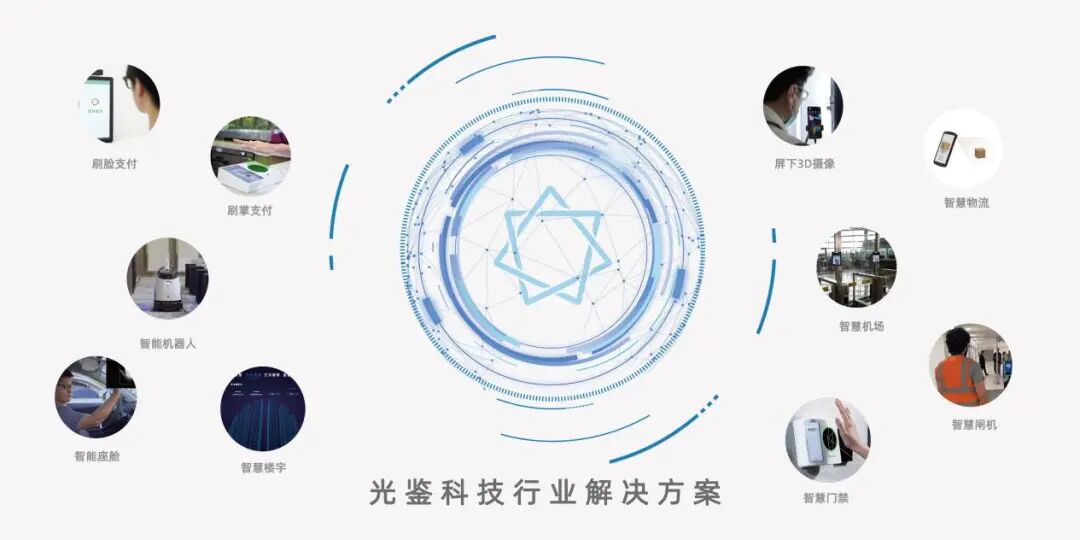
DEPTRUM industry solutions
This reporter has felt this deeply: when first contacting DEPTRUM in 2019, the company's sharing was mostly around core technology — with adoption visions given, but mostly outlooks. Today, DEPTRUM has transformed from an industry rising star with innovative technology into a leading company with cutting-edge solutions and adoption cases across many fields.
On the entrepreneurial journey, Zhu Li said: “In 2018 and 2019 our main energy was still lighting up the company's technology tree, in the pre-productization technology development stage. Five years later, we have walked the whole path from technology to product, then to having the target market accept our products — the entire commercialization process. It was not easy, but we harvested results that satisfy us.”
DEPTRUM's website shows it has successfully launched multiple products and solutions, all integrating its proprietary “optics + algorithm + computing” mindset, including the Stellar ToF depth camera series, Aurora structured-light depth camera series, Nebula sToF depth camera series, under-display 3D structured light, palm-payment solutions and smart cockpit 3D vision solutions.
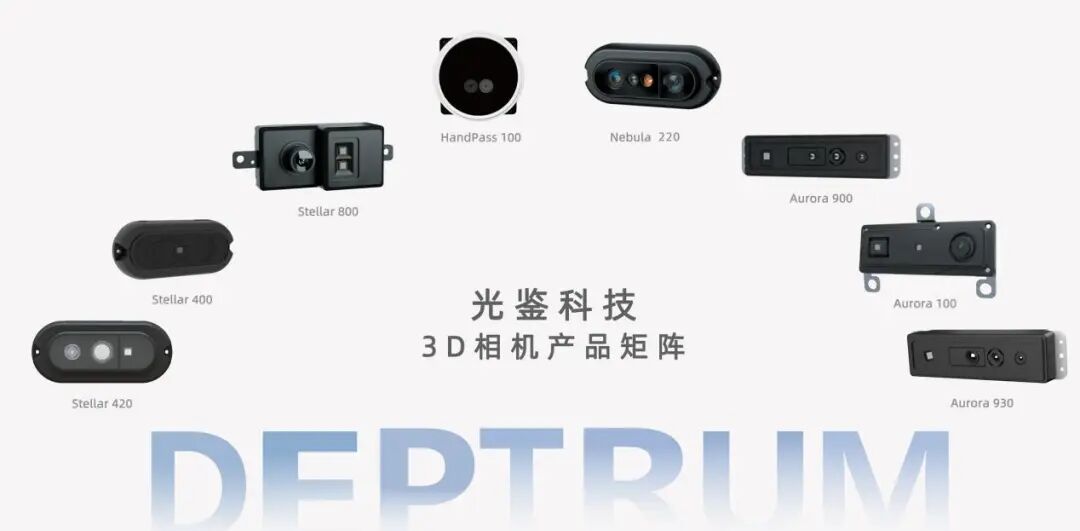
DEPTRUM product matrix
Explaining this “optics + algorithm + computing” combination for building products, Zhu Li said: “3D vision perception is, in the end, perception plus computing — it requires software-hardware integration; doing only one side leaves gaps. For downstream markets, customers need an overall optimal solution, so these three parts are indispensable. That is our advantage: based on industry-leading optical technology and a world-class R&D team, we can deliver very competitive products.”
For the entire 3D vision perception market, DEPTRUM's products and solutions are highly innovative. Of course, technology built entirely on fundamental innovation often faces bigger challenges in commercialization — DEPTRUM's achievements today were by no means easy. Zhu said the choice of a seemingly harder path relates to the two development routes DEPTRUM has set.
The first is empowering terminal markets through technological innovation. “What we want to see is innovation that does not homogenize and compete in markets where consensus already exists, but creates new selling points and value for downstream terminal markets through our technology and products, thereby reflecting DEPTRUM's own value. DEPTRUM will not make products where the market cake shrinks with competition; instead, together with the industry, we use technological innovation to grow the market — the inevitable direction for a growing technology company,” Zhu said.
Clearly this was DEPTRUM's product strategy before the Series B, and it will not change after. Products will be further upgraded — for example, at the integration level, computing chips can fuse sensing hardware with algorithms for further integration, reducing solution power consumption and optimizing performance. “More integrated solutions may bring 50%, or even higher, performance optimization.” That is one direction of DEPTRUM's next product upgrade.
Letting data speak: showing investors the truest market performance
Timing-wise, DEPTRUM completed its Series B almost at the moment of the industry capital's greatest caution — much data shows investment in the electronics and information industry narrowing — which reflects DEPTRUM's hard strength from the side. How to move investors and dispel their concerns? Zhu Li's answer was concise: let the data speak. “The Series B is about commercial conversion capability, so revenue data is our best answer to investors.”
3D vision brings clear empowering value in mobile payment, consumer electronics, automotive cockpits and robotics, bringing users brand-new interactive experiences. DEPTRUM has launched products for all these fields. “The B round tests the ability to deploy products at scale. From our business performance, we already have considerable sales scale in mobile payment and robotics, still growing fast. In automotive smart-cockpit human-machine interaction, automakers' demand keeps increasing. In automotive, both the leadership of the automakers we work with and the leadership of our technology and products will support considerable market results,” Zhu mentioned in the exchange.
In automotive today, 3D intelligent interaction is a very hot concept, and some automakers have made it standard. By introducing 3D vision perception, the high complexity of cockpit system control is readily solved. Zhu Li said: “Screens, seats, air conditioning, audio, windows and sunshades in a cockpit all interact with the occupants. DEPTRUM's cockpit solution actually goes one step beyond perception — we call it 'awareness': letting the car be aware of the driver's and passengers' states and then provide automated services.”
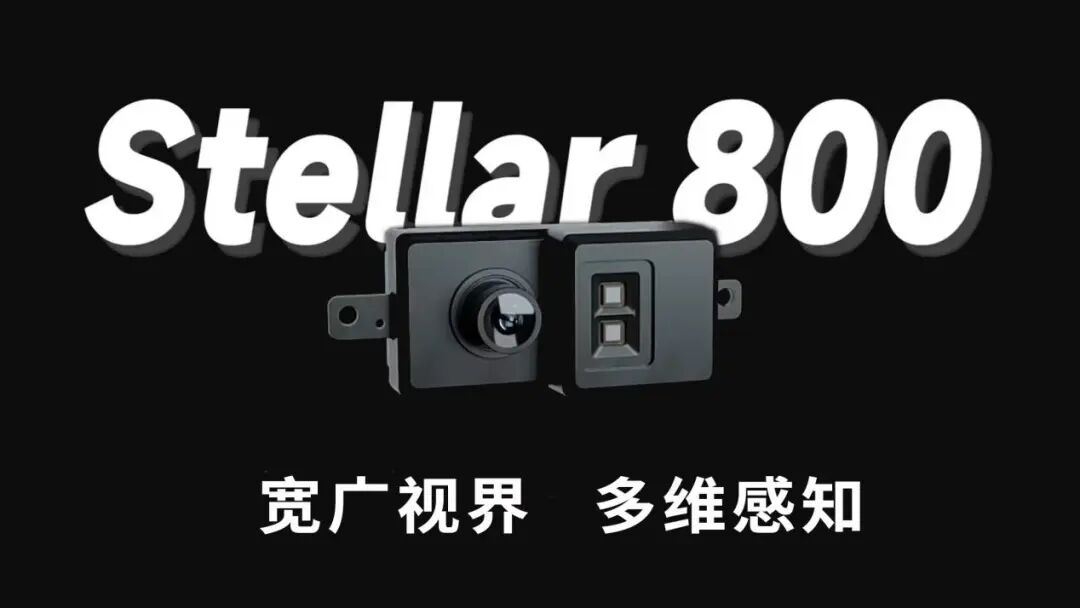
DEPTRUM automotive-grade 3D depth camera
As mentioned, DEPTRUM has two confirmed development routes — one about product innovation, the other about product adoption. That is why, in just over four years, DEPTRUM has landed an innovative technology across mobile payment, robotics, smart cities and smart cockpits.
Zhu Li said: “We have explored an efficient path of market iteration. The way is to cooperate deeply with benchmark customers, building disruptive products with full mutual trust — highly rewarding for both sides. For DEPTRUM, this opened a fast track from technological innovation to market conversion.”
Like its product innovation strategy, DEPTRUM will persistently carry out this adoption strategy.
Rooted in China, looking global: becoming a world-leading high-tech company
From a technology company's development perspective, product innovation and adoption are the core and hard indicators. Serving these two, there are also soft indicators, such as talent pipeline building, ecosystem cultivation and regional market expansion.
On the talent pipeline, Zhu Li said R&D staff make up about 80% of DEPTRUM. “After financing we expect to maintain this, so DEPTRUM will remain an R&D-focused company, with our R&D innovation focused on the markets we already serve. In market sales and organizational structure, we will also bring in more experienced talent to keep this good growth momentum.”
On ecosystem cultivation, Zhu Li said: “At this stage our ecosystem strategy is still to deeply combine our underlying technology with customers' market needs — cooperating fully when customers plan and define products, achieving more efficient conversion. In the future, for product integration, we may cooperate deeply with chip companies to further upgrade product forms. In choosing partners, what we value most is both sides' willingness to invest in innovative scenarios.”
Product innovation, adoption, talent and ecosystem — all serve DEPTRUM's company goal: becoming a globally leading technology company. DEPTRUM has therefore begun its globalization. “Relying on our local partners, at first we replicate our products and solutions; once we achieve market success, we will do more around the localization needs of other countries' markets,” Zhu Li concluded.