Deptrum Nebula 220: Reshaping Robot Vision Perception

In recent years, with continuous technological progress, machine perception technology is driving the rapid development of the AI industry. As the visual perception terminal of robots, 3D depth cameras provide robots with finer 3D information, enabling more accurate environmental perception and interaction.
To meet robots' needs for environmental perception, DEPTRUM has released the Deptrum Nebula 220 depth camera. It adopts an sToF hardware system based on nanophotonic-chip-modulated projected light fields, integrating both structured-light and ToF depth reconstruction algorithms. This design makes the structured-light and ToF 3D reconstruction performance complementary, achieving high-precision, wide-FOV point cloud output at both close and long range, and can be widely applied in robot vacuums, commercial robots and other scenarios.
The core of the Nebula 220 depth camera is DEPTRUM's proprietary nanophotonic chip, enabling light-field modulation at sub-wavelength scales with light-field projection control. Meanwhile, to fit different robot vacuum models, DEPTRUM also launched the Nebula 220 MIPI depth camera, which can be paired with a robot vacuum's mainboard for customized development, allowing DEPTRUM's 3D cameras and sToF technology to adapt to more robots.
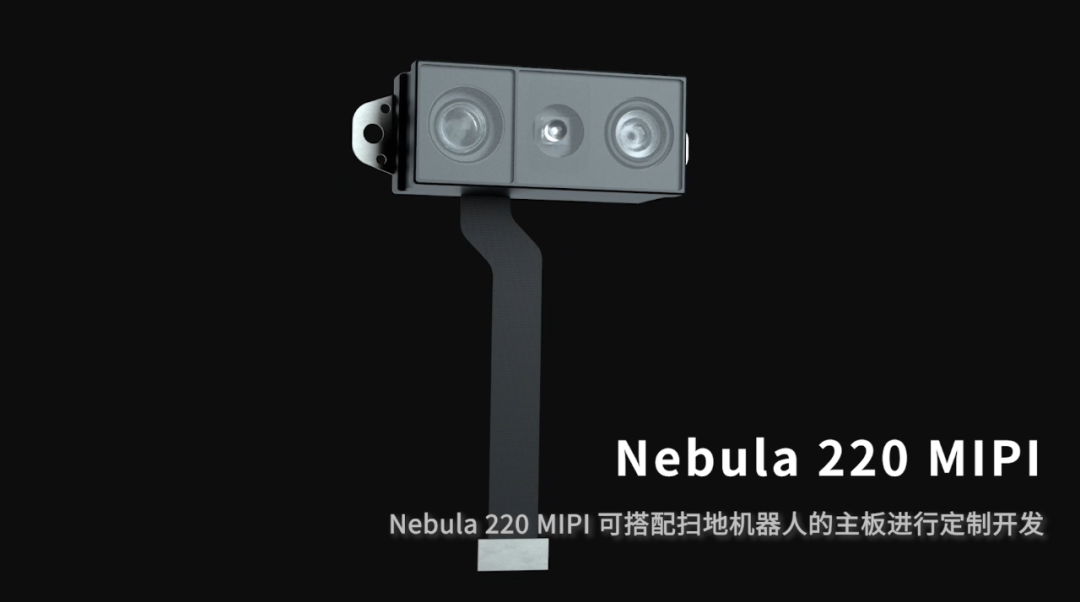
Inside the Nebula 220 depth camera, DEPTRUM's sToF technology cleverly combines structured light, suited to close-range perception, with ToF technology, suited to mid-to-long-range imaging. Working together, the two let a single module handle both close-range obstacle avoidance and long-range SLAM depth reconstruction. This proprietary 3D vision capability, based on fundamental principle-level innovation, achieves a double breakthrough in robot performance and cost.
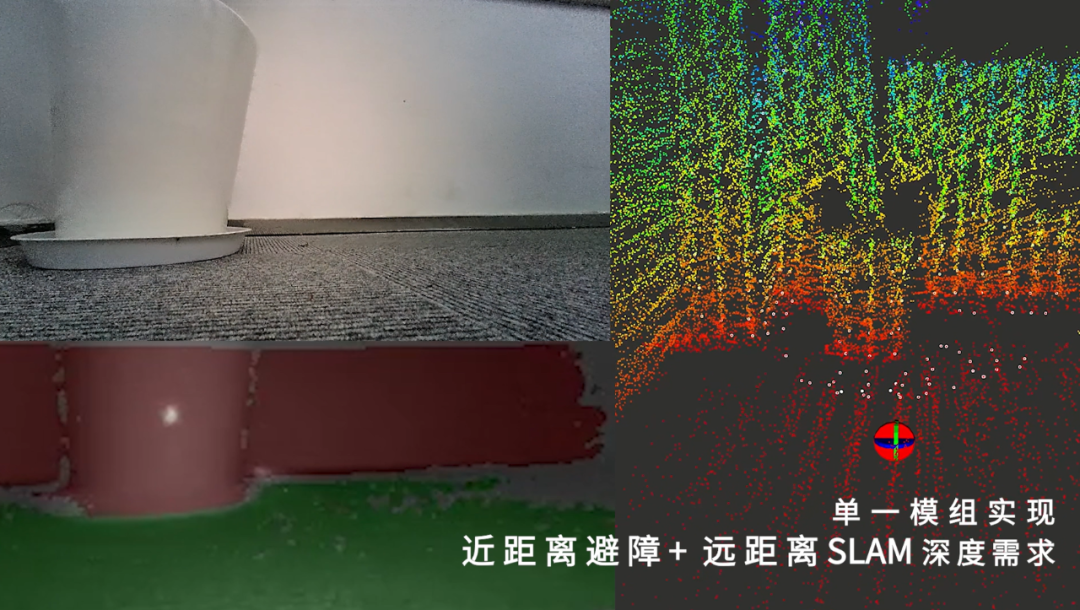
In environmental perception, robots need depth cameras to provide 3D information, so the camera's field of view directly relates to the efficiency and richness of 3D information collection. The Nebula 220 features an ultra-wide FOV design — up to 100°(H) × 75°(V) — letting robots perceive more comprehensive information in complex environments, better completing obstacle avoidance and path planning, and adapting to various working scenarios. Moreover, the Nebula 220 still performs excellently outdoors: under full-scene lighting of 80,000 lux, it can still satisfy robot obstacle-avoidance needs.
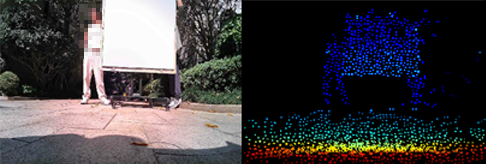
Nebula 220 outdoor result (front-lit)
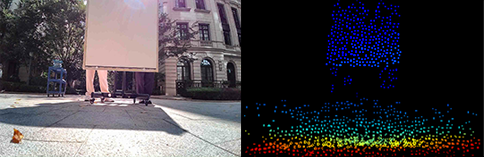
Nebula 220 outdoor result (backlit)
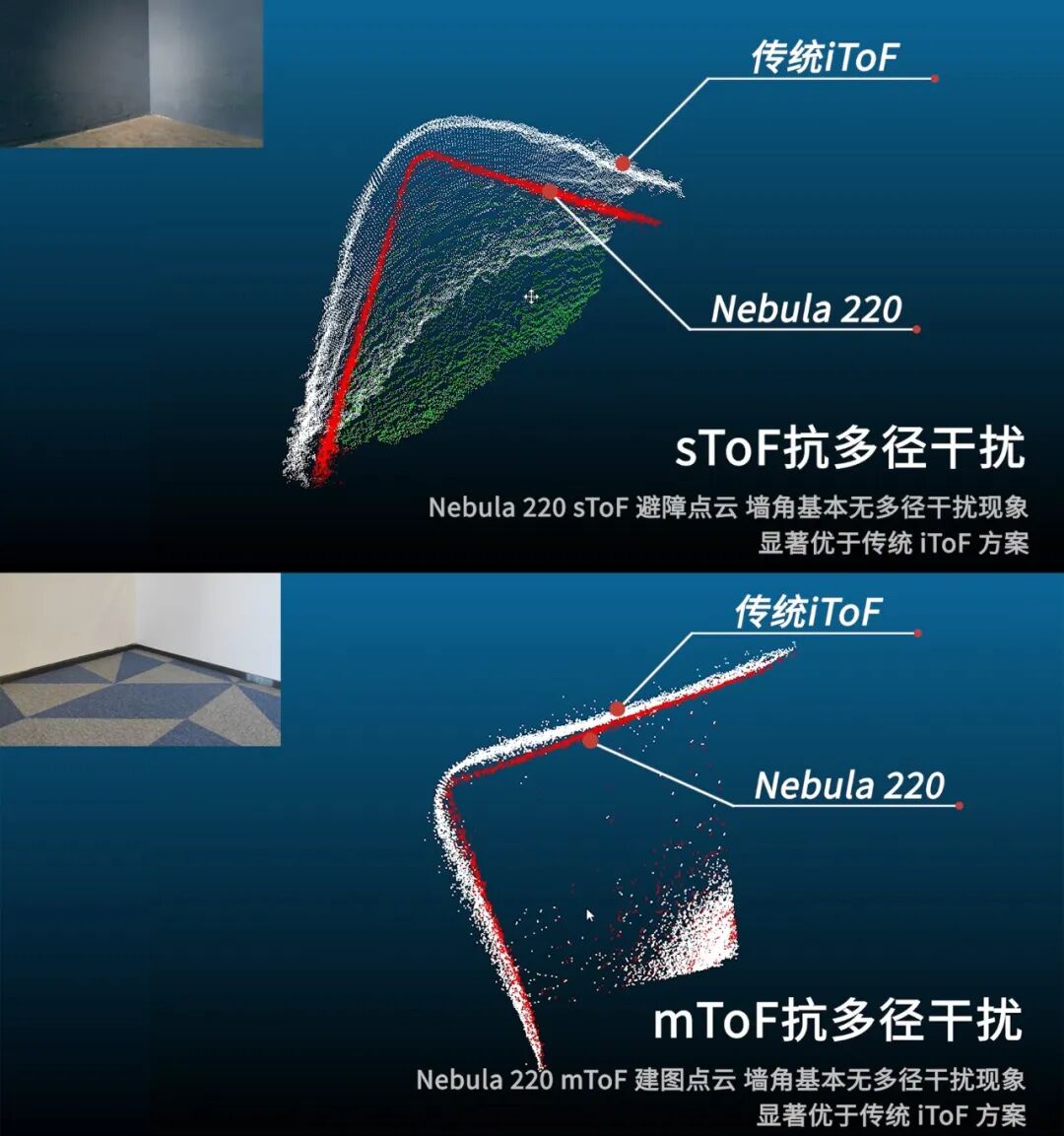
The Nebula 220's powerful perception gives robots high-precision ground obstacle recognition, accurately distinguishing common household obstacles of different colors and sizes. In multi-path interference resistance, the Nebula 220 has a clear advantage over traditional iToF schemes. At wall corners where iToF often suffers multi-path interference, the Nebula 220's sToF scheme shows no interference in either the obstacle-avoidance point cloud or the mToF mapping point cloud, completing obstacle avoidance and mapping precisely.
Overall, the Nebula 220 and Nebula 220 MIPI depth cameras have not only achieved remarkable breakthroughs in technical innovation, but demonstrated excellent performance in real applications. The launch of sToF technology will further drive innovation in the robotics industry, contributing an important force to the development of AI and machine vision.