DEPTRUM's Zhu Li: Between Innovation and Involution, We Always Choose Innovation

Foreword
THECAPITAL
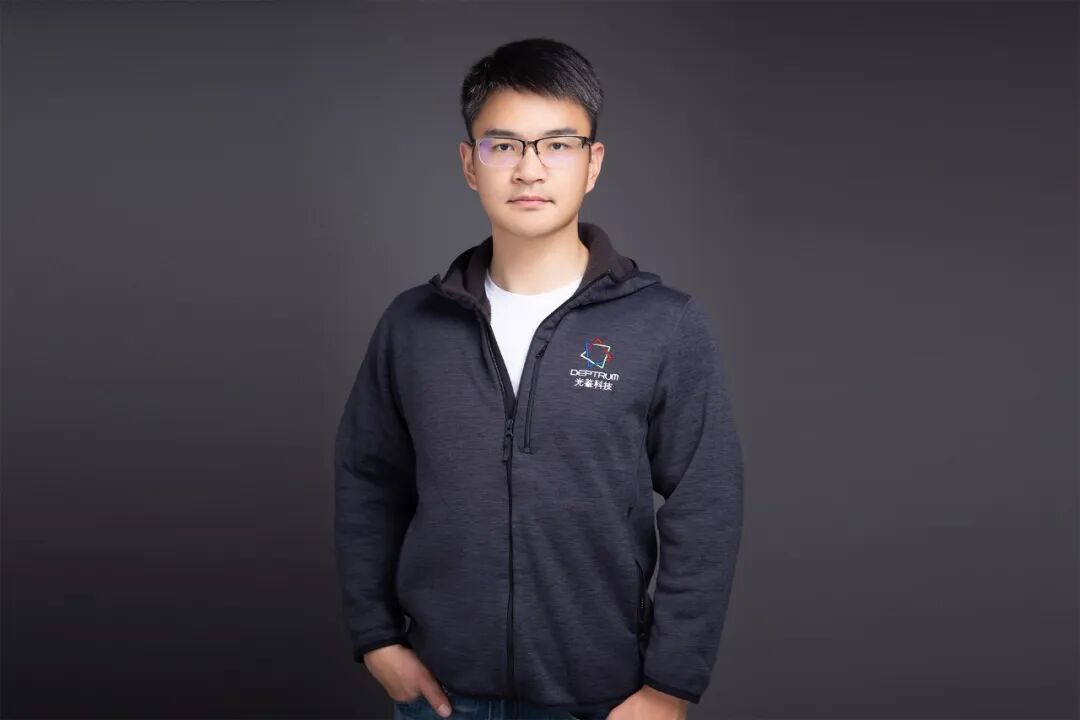
The eyes of artificial intelligence.
Last May, Beijing's Daxing Airport Line officially launched palm-scanning transit service — payment completed with a wave of the palm.
From fingerprint recognition and face recognition to the latest palm recognition, biometric technology is increasingly entering daily life. Behind these applications, the core hardware hidden deepest is the sensor. Driven by payment giants, the widespread adoption of biometrics has also driven the rise of domestic sensor tracks.
The optical module R&D and manufacturing behind the Daxing Airport Line's “palm payment” terminal is DEPTRUM. Founded in 2018, the company has spent six years pushing forward in technology, product and market; through a series of core technologies, it is moving rapidly from zero to N into its next stage.
Meanwhile, as the 3D vision industry matures and technology spreads with falling costs, more companies are entering the arena. Facing fierce competition, DEPTRUM has begun testing overseas business in search of larger markets and accelerating commercialization. DEPTRUM founder Zhu Li revealed to Rongzhong that the company achieved profitability in Q4 2023.
It is worth noting that DEPTRUM's core founding team all came from Tsinghua University's Department of Electronic Engineering. Today, three Tsinghua classmates, riding the wind of the industry's rise, are running ever faster on this track known as “the eyes of artificial intelligence.”
01
In 2015, after receiving his PhD, Zhu Li joined a Silicon Valley company to continue his research on VCSEL and nanophotonics. He soon found that China's 3D vision industry chain was still very weak — the whole track was just setting out.
At that time, mass entrepreneurship and innovation were in full swing domestically, and Zhu Li developed the idea of independently developing nanophotonic chips and 3D vision technology.
In 2018, Zhu Li brought along two Tsinghua classmates and decided to return to China to join the entrepreneurial ranks. “Wang Bo and I were in the same class, and Lü Fanglu was one year above us. Later, we all went to the US for PhDs — Wang Bo at Stanford, and Lü Fanglu and I at Berkeley in the same lab. After graduating, all three of us worked in…”
With a solid technical background, DEPTRUM attracted venture capital attention from the very start — while the project was still just an idea, it secured several million dollars in financing, and in only two months the company's valuation nearly tripled.
Although the industry developed rapidly with the rise of AI, 3D vision was still an emerging field then. “Around 2016, there were not many people in this circle; 3D vision mainly focused on industrial fields — serving large modern factories, logistics and similar scenarios,” Zhu recalled. “With AI and consumer electronics, application scenarios kept expanding.”
At that time, giant billboards in Beijing's Zhongguancun were covered with super posters bearing VR and AI logos. More and more industries and scenarios developed digitalization and intelligentization needs, driving the continuous expansion of 3D perception application scenarios — smartphones, smart cars, robots and other fields saw ever-increasing demand for 3D perception.
As technology spread and costs fell, more startups and SMEs entered the market. While promoting rapid iteration of 3D vision technology and innovation in application models, this also accelerated the industry's involution and competition.
Through years of tempering, DEPTRUM has consolidated its technology and products, moving from zero to one and into maturity.
02
Last May, the Beijing subway Daxing Airport Line launched the palm-scanning transit service with hardware support from DEPTRUM for WeChat Pay — bringing the 3D vision industry once again to center stage.
Looking back on DEPTRUM's growth, Zhu Li divides its development into two stages. “In the first two or three years, our main energy was concentrated on technology R&D, striving to gain market initiative through technological innovation.”
In that stage, DEPTRUM applied frontier nanophotonic technology to 3D vision, developing nanophotonic chips, structured-light systems, ToF systems, polarization imaging systems, 3D image processing algorithms, human-machine interaction algorithms and spatial perception algorithms around the three core layers of optical sensing, intelligent perception and perception computing.
“We achieved the step from 0 to 1 — that is, team organization building and initial commercialization.”
Now, with benchmark products, DEPTRUM has entered a new stage of scenario expansion. Its businesses cover four directions — smart terminals, biometrics, robotics and automotive — with products entering the market at varying degrees:
In biometrics, DEPTRUM mainly provides hardware support. Its palm recognition uses dual-factor verification of palm print and palm vein, with multi-dimensional imaging capturing more comprehensive palm information. DEPTRUM's technology effectively reduces interference from palm feature differences and, through AI algorithms, achieves precise user…
In robotics, DEPTRUM provides vision sensing for different types of robots. “Our advantage is that the Nebula product can achieve navigation and obstacle avoidance in one — lower overall cost and higher integration,” Zhu said. Based on sToF technology, DEPTRUM's solutions offer higher precision. Zhu introduced that the Nebula series…
In smart vehicle cockpits, as a Tier 1 supplier, DEPTRUM's solution is a vision-based human-car interaction model. “For example, DEPTRUM's smart cockpit solution enables spatial interaction between the user and cockpit function modules — controlling the screen and various in-car function modules through gestures…”
In smart devices, DEPTRUM is the only company in the world able to provide an under-display 3D structured-light solution. Previously, DEPTRUM partnered with OPPO and ZTE to launch the first flexible OLED under-display 3D concept phone and the first under-display 3D smartphone — the world's only under-display 3D structured-light technology.
“In the new stage, we have completed the process from 1 to n, and are still working from n toward 10 — that is, developing from small-scale commercial success into a stable, mature commercial foundation. That is the core goal of our company at this stage.”
03
Looking at future prospects, 3D vision perception has spread across all industries — robotics, smart devices, smart vehicles, smart homes, finance, healthcare, construction and more — with enormous market space. But on the other hand, the competitive landscape is diversifying and competition intensifying.
To meet a stronger competitive landscape, DEPTRUM has begun a “two-step” approach:
First, looking inward: deepening its own technological capability and integrated software-hardware solutions.
“What DEPTRUM wants to solve is the visual perception problem of the intelligent interconnected era — being the eyes of AI. We hope our application scenarios can cover all pan-IoT scenarios, including cars, phones, robots, door locks, payment and all kinds of devices with intelligent needs, providing them visual perception capability.”
From its founding, DEPTRUM has positioned itself as the linker of visual information, helping customers' smart devices connect to the real physical scene through vision. In terms of progress, DEPTRUM's complete software-hardware integrated solutions have been able to fit all kinds of smart devices — a capability very scarce in the entire industry.
Through this solution, DEPTRUM helps downstream applications quickly realize full-stack innovation including optics and computing, accelerating the industrialization of innovative technology.
A typical adoption case is WeChat Pay's biometric payment.
“Over the past years we have cooperated with WeChat Pay continuously, and in 2022 we won almost all the market share in WeChat face payment,” Zhu introduced. “Starting in 2023, palm products have been rolled out nationwide. Currently, in the palm recognition market, about 60-70% of the global market in 2023 was provided by DEPTRUM…”
To better advance biometric technology, DEPTRUM's R&D team keeps polishing. Zhu introduced that palm recognition is the third generation of biometric technology; compared with previous fingerprint and face recognition, its accuracy and security can meet the requirements of large-scale adoption, and…
Currently, WeChat palm-payment devices have been widely applied in transportation, sports, campus, retail, dining, office, shared charging and other fields, successfully landing at Beijing subway, 7-Eleven stores, Yingdong Gymnasium, Shenzhen University and many other scenarios, continuously promoting the popularization of palm technology and the expansion of its application fields.
Second, going outward: exploring opportunities overseas.
“A major problem in the industry today is severe involution. From the start, our direction was not domestic substitution, but using innovation to upgrade technology — that is our answer to involution. We don't want to be conformists; we want to do our best on a track that is ours alone. In our face-scanning, palm-scanning, robotics and other products…”
To find more opportunities, while addressing industry involution through technological innovation, DEPTRUM has also begun bringing its technology to the world.
“What we want to solve is a worldwide problem. DEPTRUM's technology and products remain competitive enough in the global market. In expanding overseas business, our products have also seen huge market demand abroad. So while steadily advancing our domestic business, DEPTRUM is actively going overseas to realize China's…”
Alongside deepening technology and expanding markets, DEPTRUM achieved profitability in Q4 last year. Zhu revealed: “Starting in 2021, DEPTRUM has multiplied its revenue every year, and we expect to maintain rapid growth this year.”
Looking back at the industry's changes: unlike the early days when investors flooded into the AI capital market on the “AI” hype, today's investors in 3D vision care more about product practicality. “Application” “deployment” and “commercialization” — these are the questions investors truly care about.
Through continuously landing cases, DEPTRUM has delivered an excellent report card in commercialization. Against this backdrop, last December, DEPTRUM successfully completed a RMB 200 million Series B, with participation from CICC Capital, Yicun Songling, Chongqing Kexing and other investors.
With more capital support, DEPTRUM will further accelerate its technological innovation and market expansion. “DEPTRUM has always used innovative methods to improve efficiency; between innovation and involution, we choose innovation — that better matches our team's core competitiveness.”