Structured Light + ToF: How DEPTRUM's Technology Fusion Powers Full-Scenario Robot Perception

From robot vacuums to robot dogs and humanoid robots, embodied intelligence has moved from concept to reality. As a frontier field at the intersection of AI and robotics, embodied intelligence has significantly improved how intelligent agents interact with the physical world. In building such systems, 3D visual perception is one of the core underlying technologies: by capturing and interpreting 3D environmental information in real time, it gives agents spatial understanding and interaction capability.
In an interview with Elecfans, DEPTRUM founder and CEO Zhu Li said that robots are the typical form of embodied intelligence, and that a robot's premise for interacting with the physical world is precise perception of its spatial surroundings. Take a humanoid robot picking up a cup: only by accurately identifying the cup's position and shape can it complete the action. “DEPTRUM focuses on the R&D and application of intelligent visual perception. Our core goal is to give robots precise spatial perception.”
The State and Challenges of 3D Vision Perception
3D visual perception provides depth, shape and pose information that 2D images cannot, reshaping the perception systems of intelligent agents. According to Yole Group, the global 3D sensing market reached US$8.2 billion in 2022. With the vigorous growth of autonomous driving, drones and smart home applications, the market is expected to expand to US$17.2 billion by 2028, a compound annual growth rate of 13.2%.
Yet in this rapid development, 3D vision technology routes are highly diverse, mainly including binocular vision, structured light, time of flight (ToF) and LiDAR, each with its own implementation logic:
Binocular vision: two cameras mimic human eye parallax and compute depth through image matching. However, accuracy drops in low-light and reflective environments, and detection range is limited.
Structured light: structured beams are projected onto objects and deform according to surface shape; depth and distances are computed from the deformation. Its main drawback is short effective range.
ToF: computes target distance by emitting continuous light and measuring round-trip time. It suits mid- and long-range ranging but must overcome issues such as phase noise.
LiDAR: emits laser pulses and measures echo time/phase to build 3D environment maps from point clouds. However, hardware for high-precision point clouds is usually costly and power-hungry.
Zhu Li believes current 3D vision solutions each have strengths and weaknesses. Structured light offers high near-range precision but large far-range errors — like being “nearsighted”; ToF performs well at distance but lacks close-range precision, like being “farsighted.” Robots, however, need to cover scenes from near to far, and constrained by traditional sensors they often carry multiple sets of sensors, making systems complex and expensive.
DEPTRUM's sToF deep fusion technology combines structured light's high precision with ToF's high resolution and resistance to light interference. “The difficulty of this approach lies in the synergy of optics and algorithms — mastering hardware systems, optical design and algorithm development at the same time, avoiding over-reliance on external chip compute, and achieving deep software-hardware integration through proprietary efficient algorithms to improve performance while controlling cost and power,” Zhu Li emphasized.
The robot industry is developing rapidly, with strong momentum across segments. According to IDC and other research firms, global smart robot vacuum shipments reached 20.603 million units in 2024 with sales of US$9.31 billion, up 11.2% and 19.7% year on year; the broader cleaning appliance market reached about RMB 200 billion in 2024. Meanwhile, commercial service robots and humanoid robots are accelerating commercialization.
Zhu Li pointed out that the robot industry is in a stage of rapid hardware maturation combined with deepening scenarios. Robot vacuums are mature products under continuous iteration, and delivery and cleaning scenarios already have mature deployments. With AI advancing, robots will become more intelligent and general-purpose. A robot's execution system spans sensing, perception, planning and execution — DEPTRUM focuses on the bottom-most sensing and perception layers, providing robots with high-quality 3D visual data.
DEPTRUM has launched the Nebula 240 and Nebula 400, among others, for the robot market. The Nebula 240, designed for robot vacuums, carries sToF technology that fuses the high precision of structured light with the high resolution of ToF; its actively projected coded spots effectively suppress the multipath interference of traditional iToF, achieving millimeter-level close-range obstacle avoidance within a single module.
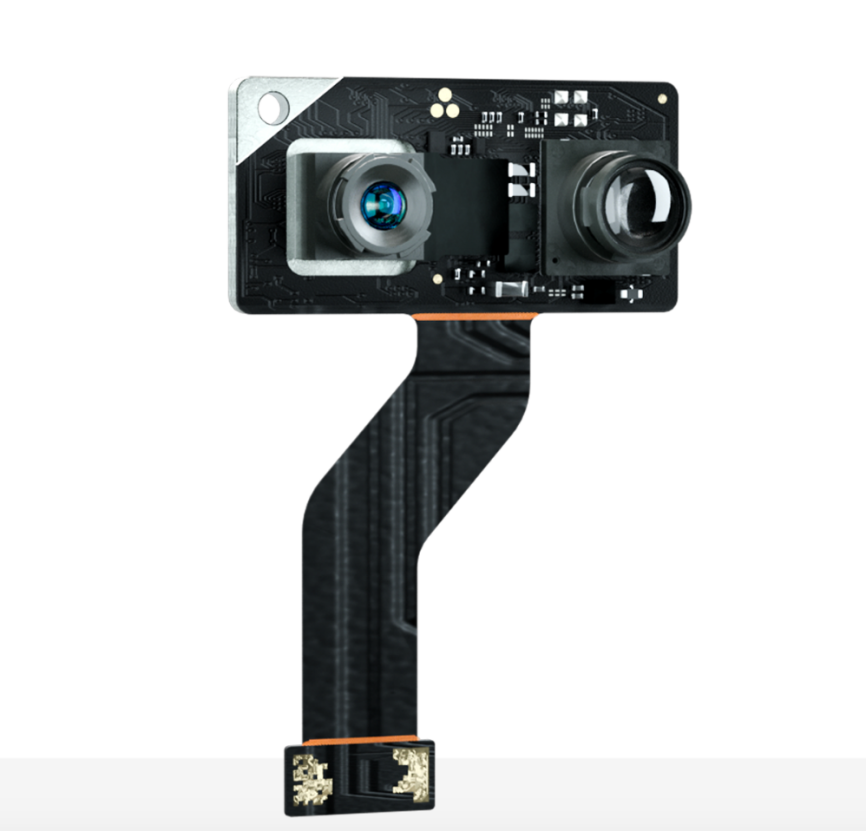
Today's robot vacuums mainly build 3D maps with line-scan LiDAR — a simple, mature approach — but line-scan LiDAR captures cross-sections only and cannot identify 3D obstacles. For intelligent development, 3D environmental information is essential, especially for high-end models with robotic arms where precise 3D perception is the core prerequisite for object grasping. Nebula series depth cameras with sToF give vacuums comprehensive near-to-far 3D perception.
Moreover, the protruding installation of line-scan LiDAR makes robot vacuums thick and unable to clean under sofas and cabinets, limiting coverage. The Nebula series can be installed inside the product, optimizing the mechanical design, reducing hardware space and cost, making vacuums thinner — and further extending working coverage and self-rescue capability.
Zhu Li called the Nebula 240's entry into the robot vacuum market a typical case of combining core technology with customer pain points: customers need upgraded recognition dimensions for intelligent perception while making vacuums thinner, and the Nebula 240 precisely fits those needs.
Taking the vacuum's core cleaning function as an example: for water stains, oil stains, milk stains or dust on the floor, if the vacuum can identify the stain type, the system can clean accordingly. On the Nebula 240 MIPI version, DEPTRUM has fused multiple sensing signals and paired them with algorithms such as ground obstacle segmentation and thin-line/stain recognition, enabling precise identification and targeted cleaning of different stains.
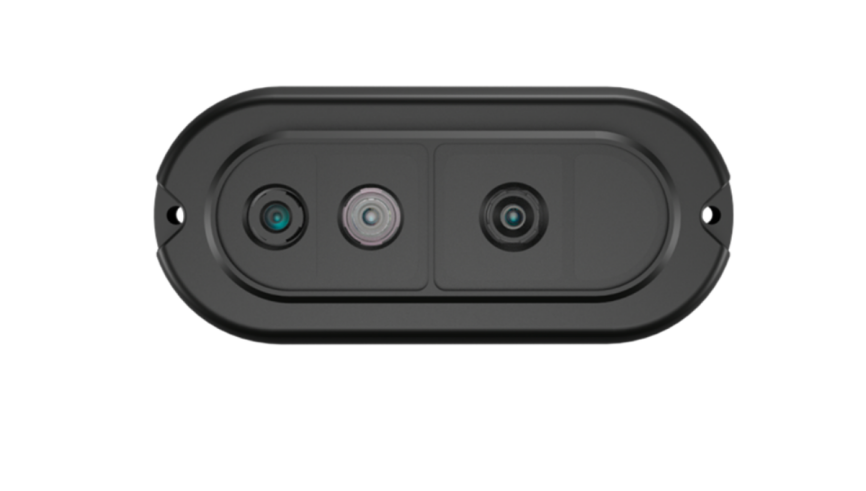
DEPTRUM's other depth camera, the Nebula 400, targets commercial robots. Commercial robots work in diverse, complex scenarios and need precise spatial information as key data support. Through the combination of 3D structured light and ToF, the Nebula 400 provides ultra-high-precision near-range and high-precision long-range depth perception, meeting navigation and avoidance needs in complex environments.
To adapt to diverse working environments, the Nebula 400 has an ultra-wide 98°(H) × 75°(V) field of view for wider, less distorted vision, improving efficiency and safety in complex scenes. Paired with DEPTRUM's proprietary color-depth fusion, 3D SLAM and object recognition algorithms, it delivers better avoidance and SLAM capability.
From these two products it is clear that DEPTRUM is not merely a hardware vendor — it has deep expertise in hardware, software and their fusion. Zhu Li said, “DEPTRUM puts great emphasis on perception computing, helping customers make fuller use of existing compute and reduce system complexity. We have deep accumulation in soft-core structured light depth algorithms, and on that basis have developed a complete toolbox covering perception, fusion and route planning, constantly expanding the boundaries of what robots can do.”

Building a 3D Perception System Like LEGO Blocks
Modular design has become the mainstream approach in robot system design, greatly improving development efficiency and flexibility. Zhu Li describes it as building systems like “LEGO blocks.” To this end, DEPTRUM has carried out work in several areas.
First, polishing every technical link of hardware and software to a mature and efficient state, advancing the standardization of 3D perception modules and solving the fundamental problems of robot-physical world interaction through technological innovation. DEPTRUM has brought automotive-grade 3D point cloud recognition to the robot industry, developing a hardware-software co-optimized system that has been published at top industry conferences and will gradually open to the whole industry.
Second, industry collaboration — achieving ultimate system efficiency through deep fusion of perception and computing. DEPTRUM is working with computing chip companies to turn its algorithms into IP, solidifying functions into chips for efficiency beyond general-purpose compute. With rich algorithm reserves in soft-core structured light depth, stain detection and 3D recognition, DEPTRUM is pushing these algorithms into customer products.
Third, strengthening data protection. Conventional cameras capture what the human eye sees, carrying high privacy risks. DEPTRUM's 3D depth cameras are non-imaging: the information they produce serves robots specifically and is inherently privacy-friendly. The company is also adding front-end data encryption and signing to further improve data security.
Finally, frontier innovation. The robot industry changes rapidly in both core technology and product form. On AI, Zhu Li noted that small models such as deep learning are already fully applied in DEPTRUM products, while large AI models will make visual perception more general — the technology is early-stage, but DEPTRUM has launched comprehensive cooperation with relevant teams. In product form, DEPTRUM will keep iterating along the direction of smaller size, lower power and higher performance.
Conclusion
As embodied intelligence accelerates toward deployment, 3D visual perception — the “eyes” through which agents interact with the physical world — is moving from technological division to integrated innovation. With the deep fusion of structured light and ToF as its breakthrough, DEPTRUM breaks the scenario limits of traditional 3D vision, achieves full coverage of avoidance, navigation and perception through the Nebula series, and reduces system complexity through hardware-software co-design, pushing the robot industry toward greater intelligence.
This article is reproduced from Elecfans (www.elecfans.com).