From Seeing to Understanding: DEPTRUM Builds Perception Infrastructure

Looking at embodied AI from first principles reveals a question that few people pause to ask: where does intelligence in the physical world actually begin?
For digital AI, the answer was straightforward. The internet had already prepared the inputs for large language models: text, images, and video existed in digital form, ready to be processed. Physical AI changes the rules. A robot must build its understanding, decisions, and actions in the physical world from the ground up. This is the source of the data shortage that has constrained embodied AI.
Perception is the first interface connecting the digital brain with the physical world.
Its significance goes beyond being the first step in a process. It defines the limits of what embodied AI can do. The world a robot receives as input determines the world it can understand and, ultimately, the world it can change. Over the past year, discussions have focused on when embodied AI will have its “ChatGPT moment,” overlooking a basic fact: before making machines smarter, we must enable them to see the real world. Li Zhu, founder and CEO of Deptrum, told Jushen Yanxishe that missing or incorrect perception cannot be corrected by even the most intelligent model to produce the right outcome.
This helps explain why robots leaving the laboratory sometimes fail in real environments. Their brains may be capable, but the world they receive through their sensors is incomplete or wrong from the outset.
Perception therefore defines the physical limits of intelligence. It is the first gateway through which a digital brain enters the physical world, and the foundational infrastructure that determines how quickly the industry can turn technology into real deployment.
The industry often misreads this value. Perception appears mature in biometrics and autonomous driving, yet the same technology can fail when transferred to embodied AI. Does this mean it has reached its limits? Zhu explains that biometrics requires precise understanding of nearby space, while autonomous driving vision primarily addresses obstacle avoidance at longer distances, without intensive interaction with objects. Embodied AI must navigate, avoid obstacles, grasp, manipulate, and collaborate with people. These tasks demand substantially stronger spatial perception.
Deptrum developed the Libra series of AI stereo vision solutions around these real requirements. Rather than making incremental changes to an established robot solution, it introduced AI models into stereo vision, designed for perception that generalizes across environments, and built an efficient computing architecture. The result supports a range of embodied AI applications while turning advanced perception technology into manufacturable, deliverable products with manageable costs.
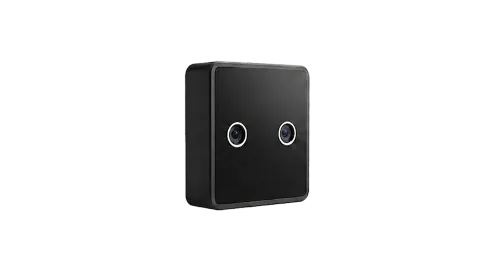
Close-range manipulation perception
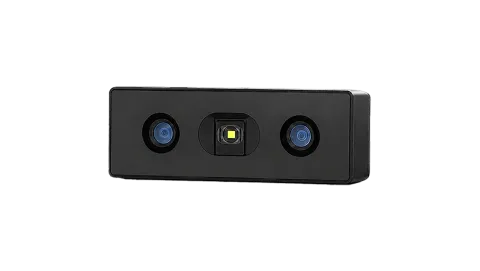
Mid- to long-range spatial perception
Effective perception infrastructure should serve the role that chips and operating systems played in the mobile internet era. A product-oriented approach can solve the common perception hardware and software problems facing robot and model developers, allowing application teams to concentrate on their core expertise without having to manage low-level hardware details.
Perception is the highway that must be built before physical AI can move forward; it cannot be treated as an optional piece of hardware.
Even the best car cannot go far without a road.

Just as embodied AI needs a brain designed for the physical world, its perception systems need an upgrade that better understands that world.
Under ideal laboratory conditions, embodied AI can perform most demonstration tasks. Real environments expose a wide range of blind spots.
The first is a widespread inability to understand common visual conditions. The physical world is unstructured and complex: transparent glass, highly reflective metal, low-texture walls, and dark, low-reflectivity objects are easy for people to recognize, but remain common weaknesses in today’s perception systems.
These are everyday features of homes, shopping centers, and production lines—a glass partition, a metal utensil, or a white wall. Failure to handle them leads directly to missed obstacles, unsuccessful grasps, and localization drift. Without solving these problems, reliable deployment at scale is out of reach.
Deptrum addressed this shared industry challenge by rebuilding the technical approach from the ground up, integrating AI natively into stereo vision instead of adding patches to a conventional architecture. This changes the underlying approach to 3D visual perception.
At the heart of Libra is a deep-learning spatial perception model embedded in the camera. Conventional stereo vision first matches pixels and then derives depth; AI stereo vision first interprets the scene and then computes depth. Its initial task is to identify scene structure and materials, selecting appropriate perception strategies for each. A conventional algorithm may treat transparent glass as empty space because it has little texture and transmits most of the light. With model tuning, geometric priors, and related optimizations, the AI model can accurately identify transparent objects such as glass doors and drinking glasses.
Libra 1000 point-cloud demonstration across different materials
Libra 3000 demonstration in complex scenes with transparent objects
This approach closely resembles human vision. We recognize glass through reflections and edges rather than assuming the space is empty. AI stereo vision gives machines a comparable perception capability for the first time.
The ability to recognize materials comes from data. Deptrum collected extensive real-world data from challenging scenes involving transparent, reflective, black, and low-texture objects, and combined it with simulated data to train a model with spatial understanding.
The algorithm learns matching patterns across different scenes and materials. It can match pixels accurately even with high noise and weak signals, reconstructing complete, continuous depth information without large missing regions. This pushes stereo perception accuracy further, delivering stable, millimeter-level depth data suited to precision work by robotic arms and dexterous hands.
Problems such as robots colliding with glass doors, failing to grasp drinking glasses, or missing small parts have, for the first time, been addressed in a camera designed for volume production.
Deptrum has brought these capabilities together in two focused products.
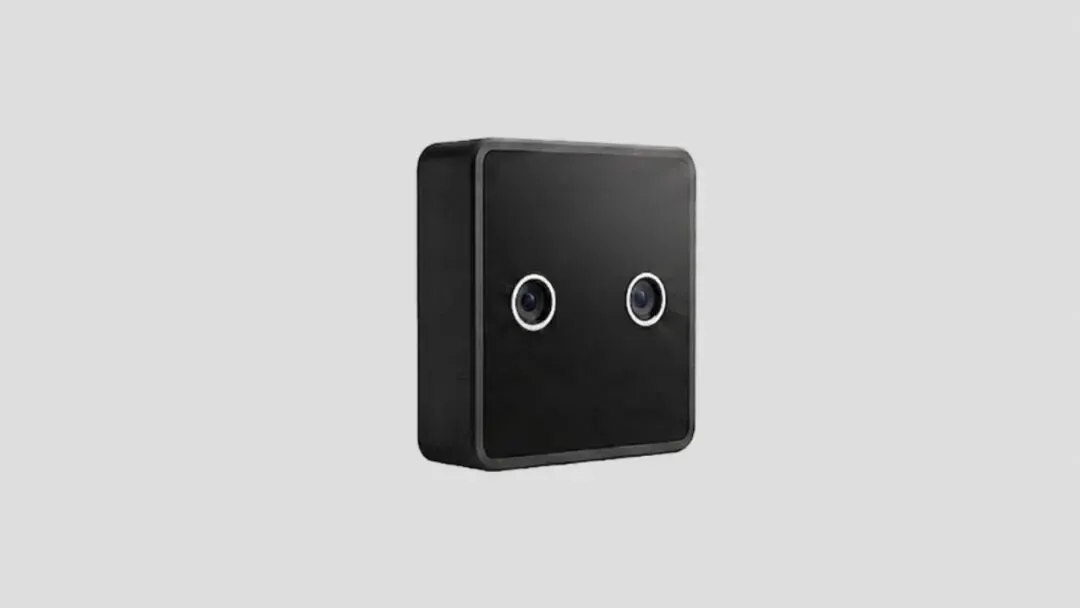
Libra 1000 uses a 2 cm baseline and is designed for wrist-mounted manipulation perception. Installed at the end of a robotic arm or near a dexterous hand, it supports close-range precision work, grasping, dexterous manipulation, teleoperation, and data collection. Optional stereo fisheye lenses provide a horizontal field of view exceeding 180°, well beyond typical industry products, addressing the need for peripheral vision during grasping.
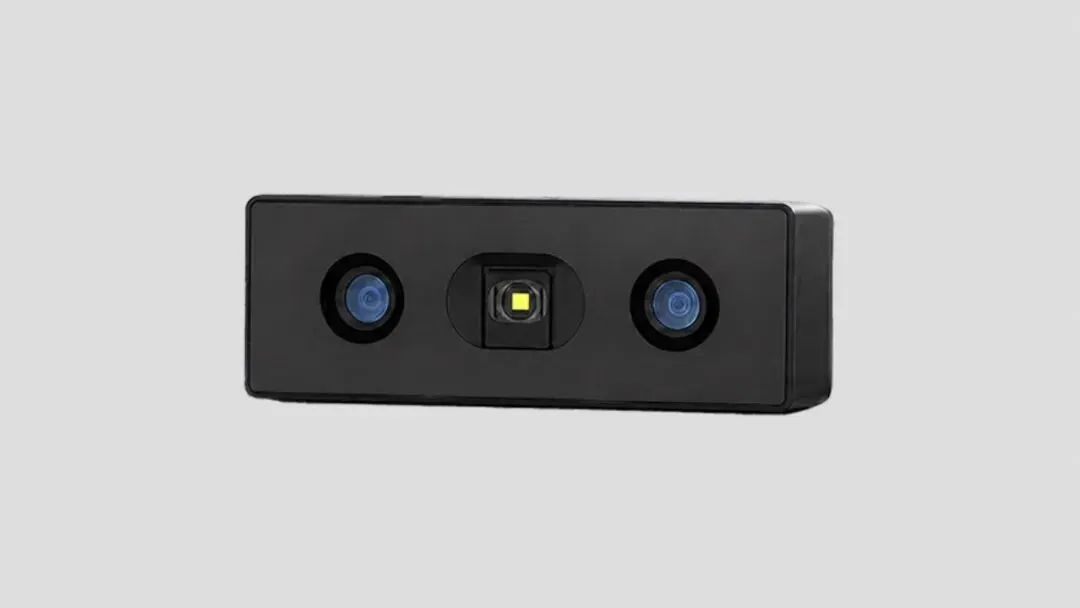
Libra 3000 uses a 7 cm baseline and is designed for head-mounted spatial perception. It delivers high-quality point clouds for medium- and long-range obstacle avoidance, SLAM localization, and spatial mapping, supporting autonomous movement and environmental understanding. Spatial perception algorithms can be integrated internally, bringing visual capture, depth computation, and spatial understanding into one system.
Together, the products address two of the most important needs in humanoid robotics. Head-mounted vision supports locomotion, coordinating the robot’s movement through space. Wrist-mounted vision supports manipulation, guiding a gripper or hand as it handles a target. One helps the robot decide where to go; the other helps it decide what to grasp.
Both modules support high-speed GMSL output through standardized hardware interfaces. “Integrating with a customer’s platform and getting it running takes a few days to a week.” Libra is already in small-batch use with leading customers in humanoid robots, industrial robotic arms, and specialized service robots. Alongside mainstream NVIDIA platforms, support has been completed for Chinese chip platforms including Rockchip and AXERA.
For embodied AI, Libra’s value extends beyond the performance of a depth camera. It addresses real-world perception blind spots: collisions caused by invisible glass, missing depth on low-texture walls, and gaps around reflective or dark objects. These recurring barriers to deployment now have a mature solution designed for volume production.
Its broader significance is a change in the role of perception within the industry: hardware that simply meets requested specifications becomes a native sensory system with its own understanding of the scene.

Technical breakthroughs expand what is possible. Product development makes those possibilities practical.
When defining products with customers, Deptrum starts with the perception problem they need to solve, rather than a list of sensor specifications they want to buy.
Grasping, for example, involves locating an object, determining its orientation, and handling occlusion from different angles. Zhu draws a comparison with autonomous driving, where LiDAR suppliers and driving-solution developers often have highly specialized roles. For embodied AI, Deptrum brings the sensor and spatial perception capabilities together in one solution. Every problem involved in enabling a machine to see falls within its remit.
As Zhu describes it, Deptrum helps customers establish the scope of perception so that they can focus on the robot’s brain.
Embodied AI operates in a complex, changing physical world. Its models must decide what to do with what they see. Limited onboard computing resources must therefore support perception, localization, planning, and inference at the same time. More capable intelligence leaves a tighter computing budget for perception; every reduction in perception workload frees resources for model inference. This efficiency is precisely what embodied AI companies are seeking.
Deptrum’s product approach takes this extra step, asking what more the solution can deliver beyond the immediate requirement.
The first answer is computational efficiency. “Embodied AI cannot offload many tasks to the cloud, so the work must be done within very limited computing capacity and physical space,” Zhu says. Cloud processing cannot meet the robot’s latency, reliability, and cost requirements. Perception computation has to take place near the camera, on the robot itself, further tightening the available resources. Zhu also points to rising memory and storage prices over the past two years and persistently high computing costs: optimizing computation can save a great deal of money. This makes edge-computing efficiency especially valuable now.
Deptrum co-designs its optics and algorithms, using model compression and careful balancing with the perception system to reduce algorithms requiring hundreds or thousands of TOPS to a fraction of their original computing demand—by a factor of several tens. More computing capacity can then go to core tasks such as VLA inference and SLAM localization that determine the robot’s intelligence.
A comparison illustrates the challenge. One leading U.S. company delivers strong results, but its solution requires an external computing unit costing around US$1,000. “If computing costs US$1,000 for one camera, three cameras mean US$3,000 just for processing. That simply is not practical,” Zhu says. According to real-world data, Deptrum’s solution achieves better overall results while reducing computing costs by at least several tens of times. For embodied AI, that difference can determine whether a product reaches deployment.
Deptrum also improves deployment efficiency by replacing the practice of adding more hardware with a unified perception architecture.
Conventional robot perception often adds a new sensor whenever a capability is missing. The resulting collection raises bill-of-materials costs, size, and power consumption. It also creates synchronization problems, inconsistent coordinate systems, higher latency, and difficult decisions when sensors disagree.
Deptrum’s AI stereo vision was designed from the outset to generalize across embodied applications. A single hardware system outputs millimeter-level depth maps, high-resolution RGB images, and dense point clouds. It natively supports SLAM mapping, autonomous obstacle avoidance, object detection, and precision manipulation without requiring additional sensors.
All data come from one optical system, enabling sub-millisecond synchronization without coordinate-system alignment issues. Latency is an order of magnitude lower than in multi-sensor solutions. Algorithms also support ongoing over-the-air updates, allowing perception to improve as more data become available and enabling new capabilities without replacing hardware.
For robot manufacturers, the benefit extends beyond saving the cost of a few sensors. It is an architectural shift from assembled components to an integrated perception system. A common data source ensures consistency, closed-loop edge processing reduces latency, and a unified interface shortens development. R&D teams can spend less time integrating perception and more time on models, motion control, and their other core strengths.
This requires a foundation of coordinated hardware and software design. Zhu sees this as essential: algorithms must guide sensor optimization, while optical capabilities must support algorithms in making the system more stable and efficient. The entire chain needs to be designed together to reach the best result.
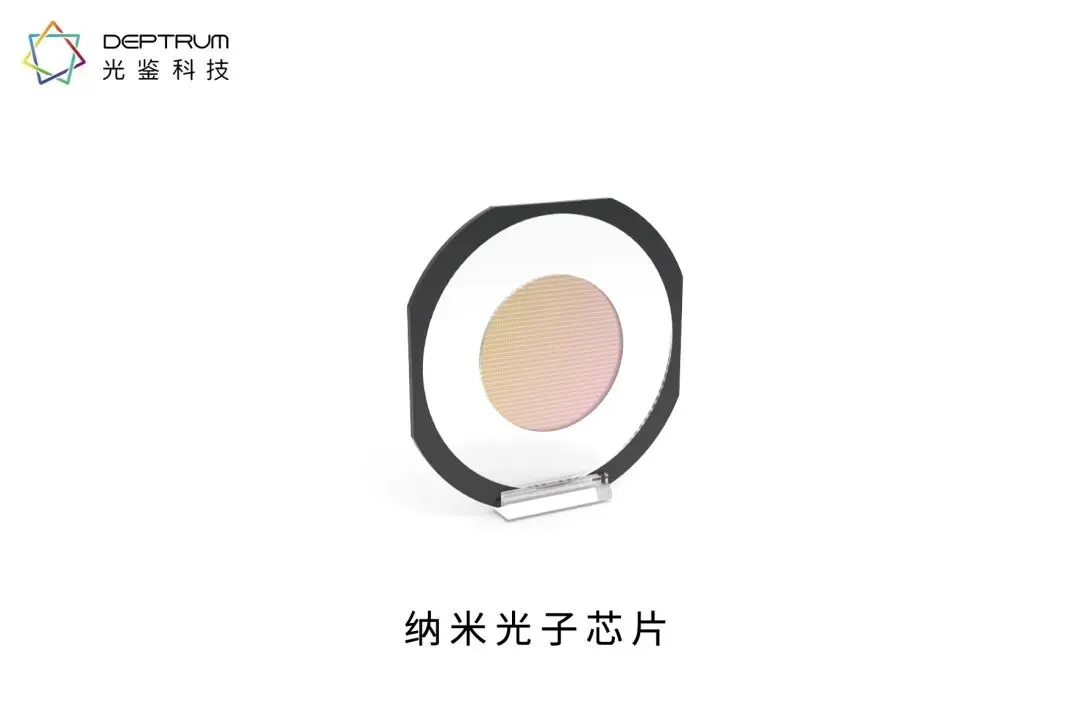
At the base of that chain are proprietary nano-optical chips that enhance the sensing capabilities and performance of optical hardware. Above them, a perception algorithm stack connects fundamental 3D spatial perception with application algorithms such as SLAM, recognition, and segmentation, together with the optics. Edge-computing optimization then enables the system to work within tight processing and physical constraints. These three layers work together to address one of the most fundamental and difficult challenges in perception.
Both computational efficiency and integrated architecture reflect Deptrum’s determination to make products that can be deployed in practice. Thinking beyond the immediate component requirement is what turns a supplier’s product into industry infrastructure.
When perception ceases to be a bottleneck, robot manufacturers can redirect R&D from repeatedly rebuilding low-level sensing toward model iteration, motion-control optimization, and application development. This is the central value of infrastructure: raising the baseline for the entire industry and giving every participant a stronger starting point for more complex real-world applications.

Since 2018, Deptrum has spent more than eight years delivering products for home, underwater, commercial, industrial, and other specialized robots. That work has built extensive engineering experience around one central challenge: keeping a system stable when lighting, scenes, and environments change. Reliability is proven through delivery, beyond what can be achieved through design alone.
That experience gives Deptrum entry into embodied AI, but the journey is far from complete.
With embodied AI advancing rapidly and its technical approaches still evolving, Deptrum has also adapted its product strategy. Continuous over-the-air updates allow the same hardware to gain capabilities as algorithms improve. Customers buy both what the product can do today and its potential to grow.
While OTA updates develop individual products over time, a broader portfolio addresses the diversity of applications. Embodied AI has no single standard form: humanoids, robotic arms, and service robots require very different baselines, fields of view, and accuracy. VLA models, world models, and other approaches also continue to evolve, each with different perception demands. A single-product development model struggles to keep pace with customer needs. A portfolio architecture can follow robot manufacturers’ iteration cycles more closely.
“People often say visual perception is already mature. That is because earlier applications had not yet reached its limits,” Zhu says. He believes perception technology is only now entering a period of accelerated development as embodied AI moves deeper into real-world environments.
In Zhu’s view, perception and models advance together. Just over a year ago, much of the industry focused on whether robots could walk steadily and perform simple demonstrations. Vision mainly needed to estimate positions and avoid collisions. As VLA and world models enable more complex manipulation, demands on perception accuracy, reliability, and generalization rise sharply. Smarter models require better input. In turn, every millimeter of improvement in perception increases training-data quality and can significantly improve task success.
Jushen Yanxishe understands that Deptrum plans to introduce data collection products. These will adapt its existing perception capabilities to data capture, making the equipment easier to use as well as functional. When capture devices and robots share the same underlying technology, data naturally transfer more effectively from collection equipment into models used to train the robot.
As attention concentrates on large models and world models—the brains of embodied AI—perception is often assumed to be a mature field with little room left to explore. Deptrum’s experience shows how much depth remains when AI begins to engage with the physical world.
The boundaries of perception continue to expand: from hardware to complete solutions, from one-time delivery to continuous improvement, and from robot sensing to a closed loop of data collection and deployment. Perception is becoming the infrastructure that helps the entire embodied AI industry advance.
Eight years of engineering experience provide a strong foundation, but they are only the beginning. The possibilities for visual perception in the physical AI era are just starting to unfold.