DEPTRUM Introduces 3D SLAM for Embodied AI, Opening New Possibilities in Robotic Spatial Perception

Embodied AI is moving from technology exploration into commercial use. Yet bringing robots into homes and businesses still requires a more integrated, affordable way to perceive and understand the physical world.
For embodied robots, perception bridges the digital and physical worlds. Robots need to do more than detect obstacles: they must understand spatial structures, determine their position, and use environmental information to move autonomously and carry out tasks.
To address this need, Deptrum has introduced a 3D SLAM solution for embodied AI. Combining its Nebula 411 depth camera with the proprietary HyperCube 3D SLAM algorithm, the solution enables whole-home 3D spatial perception, RGB-D mapping, SLAM localization, autonomous navigation, and intelligent obstacle avoidance. It offers a compact, affordable approach to spatial perception designed for volume production in home robots.
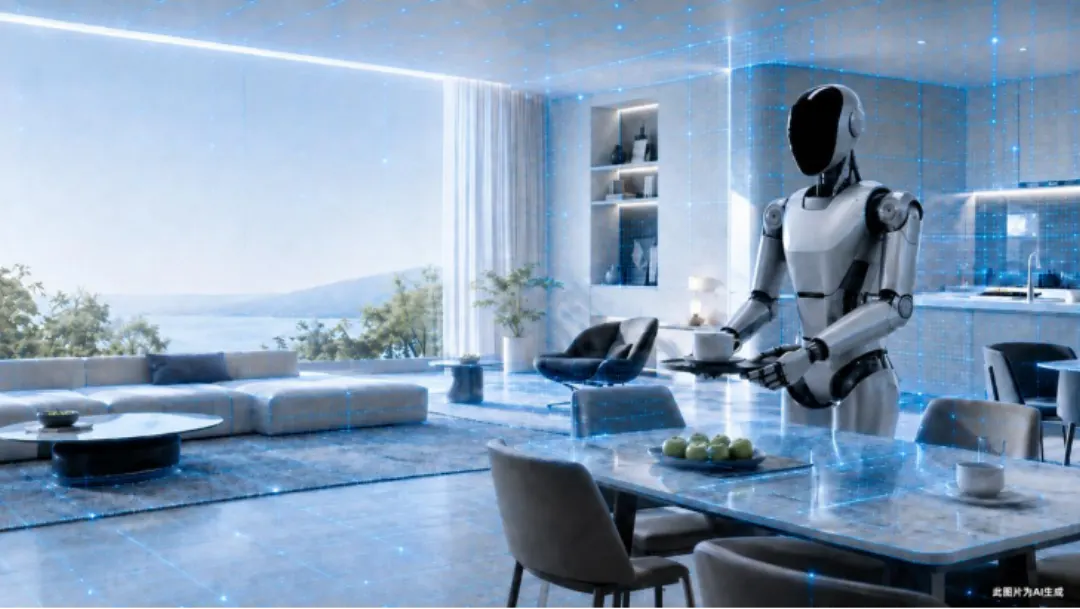
From Sensing Environments to Understanding Space
As embodied AI enters more applications, robots demand more from their perception systems. LiDAR, with accurate ranging and established navigation algorithms, has played a key role in mobile robot localization and path planning, helping products such as robot vacuums become widely adopted.
More complex embodied AI applications require a comprehensive understanding of spatial structure, position, and motion, beyond distance measurements alone. Conventional LiDAR mainly supplies range measurements and environmental data, while spatial understanding depends on additional computing and algorithms. Two-dimensional LiDAR offers limited support for 3D spatial understanding; 3D LiDAR faces cost, size, and integration challenges that constrain large-scale deployment in home robots.
Deptrum’s solution combines multiple Nebula 411 depth cameras with HyperCube 3D SLAM to meet the need for integrated perception. It unifies visual sensing, spatial computing, and environmental understanding, from data capture and mapping to localization, navigation, and intelligent obstacle avoidance.
Once operating in an environment, the robot continuously captures spatial information at distances of up to 8 meters. As it moves, it collects data in multiple directions and fuses this with IMU measurements to build an RGB-D model containing both spatial structure and depth information. This provides a reliable foundation for autonomous navigation, path planning, and task execution.
Demonstrations show front and rear depth cameras working together to capture continuous spatial information at real-world scale. The front camera supports modeling and navigation, while the rear camera fills gaps during turns, reversing, and body occlusion. Together, they reduce blind spots and accumulated drift, produce clearer boundaries for walls and furniture, and build more complete, accurate maps for stable navigation in complex environments.
Compact, Affordable, and Integrated for Deployment at Scale
Perception is only the starting point for intelligent robots. Reaching mass-market deployment also requires practical solutions to cost, size, computing requirements, and product design.
Compared with conventional LiDAR-based architectures, Deptrum’s 3D SLAM solution reduces system complexity by integrating spatial perception, localization, and navigation into a unified system. This better supports product development, particularly in homes, where perception modules need to be compact, visually unobtrusive, and easy to integrate as well as high-performing.
Nebula 411 measures just 66.6 × 30.2 × 21.3 mm. Its compact design delivers extensive spatial perception capabilities while freeing up space inside the robot. The module fits naturally into the robot body, giving industrial designers greater flexibility.
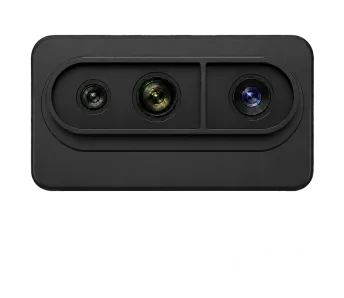
- Maximum depth range
- 8 m indoors
- Minimum depth range
- 3 cm
- Maximum depth field of view
- 98° × 72°
- Ambient illumination
- 100,000 lux at 2.5 m
- Communication protocol
- USB 2.0
- Object recognition
- Optional algorithms
- Spatial perception
- Optional 3D SLAM algorithm
- Image output
- Synchronized RGB-D
An optimized computing architecture also enables Nebula 411 to recognize and understand spatial information with modest computing demands. This reduces the load on the robot’s main processor, leaving more capacity for large-model inference and intelligent decision-making.
Cost is a decisive factor in bringing embodied AI into homes. Deptrum’s solution offers a significant cost advantage over LiDAR-based systems, balancing perception performance, system complexity, and cost to make deployment at scale more practical.
Deptrum also brings established experience in commercializing robot vision. Nebula 3D vision products are already deployed at scale in robot vacuums and proven in the consumer robotics market. This experience in integration, cost control, and volume delivery provides a strong foundation for expansion into embodied robots.
From Nebula to Libra: A Broader Vision Portfolio for Embodied AI
Embodied AI requires visual capabilities that span different robot designs and applications. Drawing on its experience in active visual perception, Deptrum continues to expand its embodied AI portfolio to meet these diverse needs.
The Nebula series primarily serves home and indoor robots, combining 3D vision and SLAM for spatial mapping, autonomous navigation, and intelligent obstacle avoidance. The Libra series of AI stereo depth cameras extends these capabilities to spatial perception and precision manipulation, supporting robots from movement through to object handling.
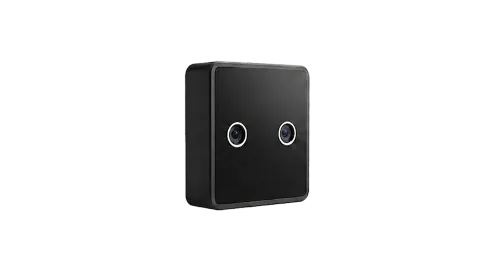
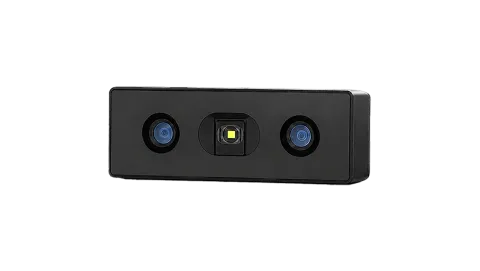
Deptrum will continue advancing vision hardware, perception algorithms, and computing architectures together. Our goal is to deliver more affordable, integrated solutions that are easier to deploy at scale, building visual perception infrastructure for physical AI and accelerating the adoption of embodied intelligence.